




From Khorasan to the Indus and Beyond
Author: Arif Hasan Khan Akhundzada, researcher and analyst on regional affairs, member of the Advisory Council of “Sangar”
Ladies and Gentlemen – it gives me great pleasure to address this august gathering, on the occasion of the 35th Anniversary of the Independence of the Republic of Tajikistan!
I thank the National Academy of Sciences of Tajikistan for honouring me, by inviting me to participate and deliver my views on the topic of the day!
I feel that I am no stranger in Tajikistan. As a person of ethnic Tajik descent and identity, I feel at home in a country the name of which corresponds to my ethnonym. I am proud to proclaim this label in my own country Pakistan, which has a sizeable indigenous population of people who recognize themselves as Tajiks.
The fact of the matter is, that all Tajiks are heirs to the magnificent culture of Iranshahr – the glorious legacy of the ancient Persian Empire, which though it no longer exists in political form, has left its everlasting and indelible ethnic, cultural, racial and linguistic legacies over the whole region that now comprises Pakistan, Afghanistan, Iran, Tajikistan, the rest of Central Asia, Kashgharia, the Caucasus, Anatolia Turkiye and many more lands and contexts.
The influence of the Iranian branch of Indo-European civilization and its ethno-cultural continuum had once spanned in one form or another -- the whole of Eurasia from Scotland and the shores of France right upto the western reaches of China. It comprised the eastern offshoot of the vast Indo-European civilizational movement in Eurasia, and was known as the Indo-Iranian or Aryan civilization. It gave birth to two major civilizations of antiquity including the first global empire centered on Persia and the Indo-Aryan Vedic civilization, together with its later ramifications.
Persia as a civilization comprised the very core of developed Iranian identity. It was built upon the eastern Indo-European Aryan character. It also partook of the legacies of the earlier Elamite and Assyrian inhabitants of the Iranian Plateau and fused them into its own body, taking them along on a new trajectory of glory sand development – in the manner that any real civilization must.
The Eastern Iranian Scythian nomadic Turanian cultures centered on the Great Eurasian Steppe beyond the Oxus, also birthed the great Sogdian and Bactrian trading cultures of Khorasan and the Eurasian Silk Route, now exemplified in the modern nation-states of Afghanistan and Tajikistan. The kindred Saka Scythian and Kushan-Tocharian Eastern Iranian nomads migrated down through Bactria towards India and the Sulaiman Mountains – where they laid the foundation of the Pashtun-Afghan tribes in Sistan and the peripheries of Gandhara. Some of them remained behind in the Pamir Mountains, where their descendants are now represented by the modern Tajik communities of Badakhshan.
All of these are the proud members of the vast Iranian nation. Most of them own the Tajik label. They all proudly own that deep organic ethnic identity, while pledging allegiance to their respective modern political identities. Tajiks are thus the heirs to the historic legacy of the mighty Indo-European Aryans of Eurasia, fused with the ancient nations that preceded them.
As a modern country, Tajikistan can be proud of the fact that it identifies itself primarily as the standard bearer of Aryan and Iranian ethnic and cultural legacies in the region!
***
Regarding my own clan in Pakistan, the Swatis or Sawadi Dehgans – I am proud to say that it is represented in all the stages of the history of Iran, with its origins extending to before the Aryans. Unfortunately very few are publicly aware of these facts. A satisfactory and standard exposition of the Pashtun-Afghan society where we live, has yet to be conducted, and the reasons are numerous. The Swatis are among a category of a handful of minor auxiliary or attached Iranian clans inhabiting the Pashtun-Afghan society, whose Pashtun pedigree is “doubtful” and whose former linguistics and genetic lineages are older and do not belong in the standard Pashtun-Afghan Scythian tribal trees. Therefore their provenance is described as Tajik and non-Pashtun.
The name Swati is actually the recent corruption of a term derived from “Sawad” which has Mesopotamian origins dating back to before Persia. Our roots lie in the ancient Elamite-Assyrian bedrock of the area, and are centered in Sistan and represented by the ancient Helmand Culture that predated the Bactria-Margiana Archaeological Culture (BMAC).
With the establishment of the Achaemenid Persian state, we were among the first to join it and declare loyalty to the new identity: our traditions still own “Sikandar Zulqarnain” or Cyrus the Great as our honorary father figure. Till 500 years ago, the Swati aristocracy spoke the ancient Zoroastrian dialect of Middle Persian known as “Gabari” which is still spoken in Yazd and Kerman.
We also carry in our tribal designations terms such as “Gabari” and “Mitravi” which still reflect our ancient and forgotten allegiances to Zoroastrianism and Mithraic cultism – despite being Muslims since the time of Sultan Mahmud of Ghazni. We still use the ancient Persian term of “Dehqan” to characterize our social class. Although circumstances have forced us to speak Pashto in the past four centuries or so – we own a clear and proud identity of separate origin from the rest of the Pashtun-Afghan tribes.
Swati tradition states that we are descended from the Rutbil or Zunbil rulers of Sistan-Zabulistan. The Rutbils were old local princes who came to prominence in the immediate aftermath of the Sassanian overthrow and kept Islam at bay in Sistan during their 250-year rule in which they were allies of the Kabulshahi Hindu rulers.
When the final Rutbil was overthrown and killed by the first Muslim Iranian ruler Yaqub-e Laith Saffari in about 872 – his clan, dependents and supporters fled north to Balkh where they remained for a few decades. They finally ended up further east in the Darra-ye Pech valley of the present-day Kunar Province of Afghanistan. There they converted to Islam, and in about 1190 their chiefs, the brothers Sultan Bahram and Sultan Fahkal or Pakhal became part of the Ghurid armies and conquered for themselves a kingdom known as Sawad-Gabr which became a vassal provincial Sultanate of the Delhi Sultanate.
Our Swati Dehgan clans played a prominent part as being sub-rulers of the Pashtun-Afghan regions in Khorasan from the days of Sassanid Persia. During the Ghurid era, we played a part in the conquest of India and setting up of the Delhi Sultanate, of which my ancestral ruling Jahangiri Swati clan remained vassals, titled as the Sultans of Swat. Later on, some rebel Swatis were involved in helping establish the Bahmani Sultanate of South India.
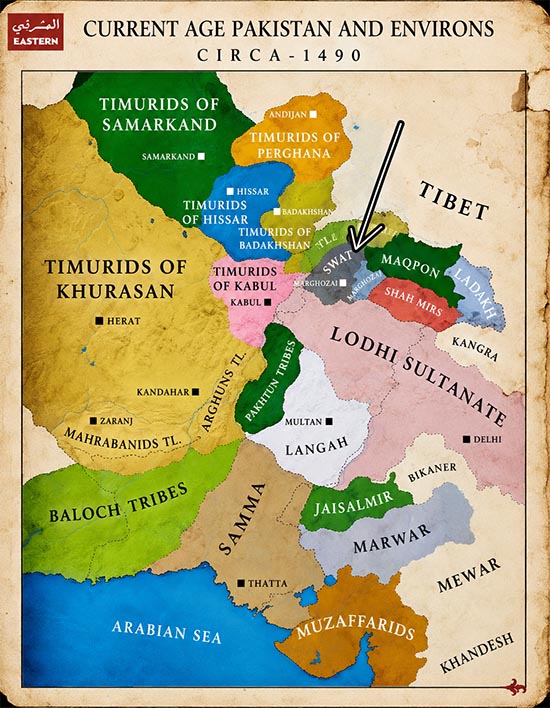
In its heyday, the Swat Sultanate extended from Tagab and Parwan near Kabul, to Baramulla in Kashmir. In the north, it extended to the River Panj and Wakhan, and in the south it ended at Peshawar. It lasted in diminishing form from 1190 to 1520. Kashmir’s royal clan of the Shahmiri Sultans was founded by a Swati adventurer Shah Mir in 1339, which introduced Islam and Khorasani culture to that beautiful land.
The prominent Persian mystic of Kashmir, Mir Sayyid Ali Hamadani was an intimate friend of the Swati Sultans. He later fell out with Sultan Aliuddin Jahangiri on account of his drunken ways. Hamadani’s death took place in 1386 in Swati territory, but he had instructed his companions to convey his body back to Khatlan, from what he termed as an “unholy place.”
Earlier, it was during the time of Sultan Jahangir Gabari-Sawadi that Genghis Khan invaded this area in 1222 and suffered his most stunning defeat at Jabal-us-Siraj in Parwan at the hands of a joint army of Swatis, Khwarezmshahis and Khilji Ghurid troops. The Swati ruling dynasty hereafter took on the name “Jahangiri” in honour of their illustrious forebear.
It was the depredations of the Timurid Princes that finally brought about our downfall. Ulugh Beg II, ruler of Kabul murdered the chiefs of the Afghan Yusufzai tribe in about 1481, the remnants of which fled to Swat and were given refuge and accommodation by my ancestors. These treacherous tribesmen were later used by the Indo-Timurid Prince Zaheeruddin Babar to topple the last Sultan of Swat, Awais II – and later to conquer and overthrow the Sultanate of Delhi in 1526 and establish Mughal rule in India.
Most Swatis thereafter crossed the Indus River and re-occupied the adjoining Hazara region of northern Punjab and Kashmir, which is where they still live today and number about 2 million. That is where we began losing our original Middle and New Persian languages some 400 years ago.
Finally, before I leave you – I would like to mention that my particular approach to investigating local history involves the subject of Population Genetics. In this regard, I woiuld like to mention the name of a young colleague of mine in Tajikistan, the archeologist Mr. Sherzod Asrori who works at the National Museum of Tajikistan and is doing his Ph.D dissertation on a batch of ancient DNA sampoles collected from the ex-Soviet Cetral Asian region – with a view to determining the ethnogenesis and compiling a profile of Tajik ethnogenesis. This is exactly the work I am pursuing.
A case in point is the example of my paternal Y-chromosome Q2b1and its special relevance to Tajiks. This is the paternal line characterizing Swati clans, including my own Jahangiri royal clan in Pakistan. It is also the patyernal line of the late Commander Ahmad Shah Massoud of Panjshir, Afghanistan. Additionally, it is the paternal line of the notable Rustami family of Khojand, Tajikistan to which the famous archery champion of the Montreal Olympics Zebunissa Rustami belongs.
Needless to say, a state with the name of Tajikistan represents a node from which Tajiks can be confident to derive sustenance for their identity – and proceed confidently in these times of uncertainty, instability and radical change.
Ladies and Gentlemen!
Having expressed my views about the magnificent Aryan legacy which Tajikistan now represents for all of us – and having introduced the history of my Swati Tajik clan of Pakistan to you – I feel that I have fulfilled my purpose at this conference and therefore must beg my leave of you. The rest of my colleagues here will dwell upon the other aspects of the matter. But before leaving, however, let me end by saying that the excellent legacy of Iranian civilization still lives as it has for the past thousands of years, and is as relevant to our future as it ever has been – especially in these troubled and extremely critical times for this region and the world in general. And it will continue to guide us, its children – in that respect. It holds the key to our future and continued survival!


