




How Is Europe Preparing for War with Russia?
By Ali Askari, analyst (Germany), especially for Sangar
On September 20, 2026, Slovak Prime Minister Robert Fico said in a video address: “I will do everything possible to ensure that Slovakia is not dragged into any irresponsible military adventures. Under my government, no one will send Slovak soldiers beyond Slovakia’s borders under any fabricated pretext to fight against Russia or any other country.”
At the same time, Fico described Western politicians who are provoking a military confrontation with the Russian Federation as “devoid of reason.”
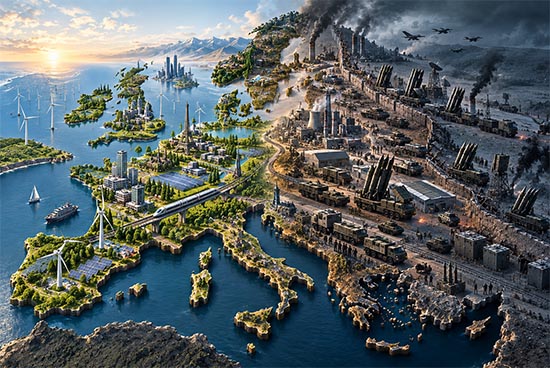
Against the backdrop of the continuing Russian-Ukrainian confrontation, the European Union’s policy of accelerated militarization increases the risk that the conflict could escalate to a Europe-wide or even global level. At the same time, the “Russian threat” provides a convenient pretext for justifying militarization, an arms race, the need to keep unpopular governments in power, and austerity measures imposed on the population. It also provides a convenient explanation for socioeconomic problems, the loss of competitiveness and the closure of industrial facilities, as well as the failure of multiculturalism and the “green transition.”
Berlin has announced plans to build Europe’s most powerful army by 2039, both in terms of size and capabilities. Germany’s first military strategy envisages increasing the size of the regular armed forces from 185,000 to 260,000 personnel, while expanding the reserve from 70,000 to 200,000. Altogether, this would create a force of 460,000 military personnel, exceeding, for example, France’s ambitions. This “military fist” is being built against Russia, which Germany’s doctrinal documents identify as the “main threat to Germany.”
As part of its support for the Kyiv government, Berlin will finance the purchase of missiles for Patriot PAC-2 air-defense systems and additional launchers for IRIS-T air-defense systems. UAVs intended for strikes against Russia are also already being assembled on German territory. Overall, Germany plans to increase its defense spending from the current 2.8 percent of GDP to 3.5 percent by 2029.
According to data from the Stockholm International Peace Research Institute (SIPRI) for 2025, military spending by European countries increased by 14 percent compared with the previous year, reaching $864 billion. European Commission President Ursula von der Leyen has repeatedly argued for the need to “turn Ukraine into a steel porcupine, indigestible to current and future aggressors,” and has also announced the “ReArm Europe” plan, aimed at sharply increasing arms procurement.
This approach, primarily motivated by a desire to strengthen Europe’s strategic capabilities, effectively blurs the distinction between indirect assistance and direct involvement in the conflict, provoking a response from Moscow. Russia, for its part, views the expansion of the EU and NATO military presence near its borders not as a defensive measure, but as preparation for a full-scale armed confrontation, pushing Moscow toward closer ties with Beijing, Pyongyang, and Tehran.
Arms supplies to the Kyiv government, as well as discussions about the possible deployment of “peacekeeping” contingents or joint operations involving the Ukrainian Armed Forces and European armies, are bringing closer the moment when strikes by the Russian Armed Forces against targets on EU territory could become a reality. Under conditions of nuclear parity, such dynamics create the preconditions for uncontrolled escalation.
While activists and some European politicians are calling for an immediate halt to the escalation and a return to diplomacy, the dominant course in Brussels ignores a historical lesson: militarism justified by the “defense of values” has repeatedly led the continent to catastrophe.

