




How Israel and the U.S. Are Seizing the Levant?
Author: Ibrahim Majid
Original article: تجزیه سوریه - آغاز تجزیه شرق نزدیک
The war in Syria marked the first and most crucial step in the grand Western plan to fragment the Middle East. While Western media portrayed this conflict as an internal struggle for democracy and freedom, the reality was entirely different.
After the 2006 war between Israel and Lebanon, Israel’s Institute for National Security Studies reached a strategic conclusion: in order to dismantle the axis of resistance, the heart of that axis — Syria — had to be struck.
Just as the heart circulates blood throughout the body, Syria transmitted financial support, weapons, and logistical backing to the entire resistance network. The country was the link connecting Hezbollah, Iran, and Palestinian groups. Israel concluded that the only way to break this axis was to fragment Syria into religiously conflicted regions so it could no longer serve as a unifying force.
A Strategic Target — The Heart of the Region
Syria, with its strong national identity, deep ties to the resistance axis, and central geographic position between Iraq, Lebanon, and Palestine, posed a major obstacle to the “New Middle East” project promoted by U.S. neoconservatives and Israeli strategists.
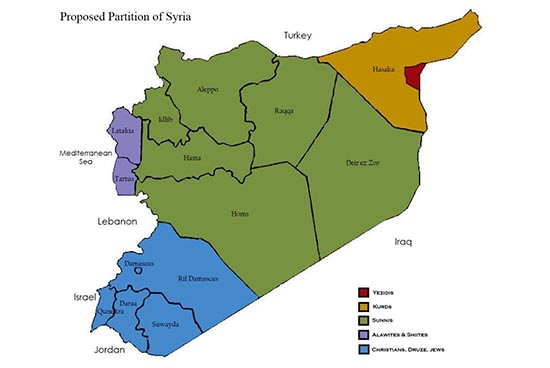
The goal was not merely regime change, but the complete dismemberment of the country:
- Creation of an Alawite state along the western coast;
- Establishment of a Sunni Arab state in the central region;
- A Kurdish autonomous region in the north;
- Dispersed autonomous zones for Druze and Christians — all separated from each other, while Israel occupies southern Syria.
Such partitioning would weaken Syria as a regional actor, cut the land corridor between Iran and Lebanon, isolate Hezbollah, and pave the way for full U.S. and Israeli control over the Levant (Sham).
Engineered Chaos: Proxy Forces, Militants, and Media Warfare
To implement this strategy, the following steps were taken:
- Inciting sectarian tensions and turning communities against one another through propaganda and psychological warfare;
- Sending radical militants into Syria, many affiliated with Al-Qaeda and ISIS, armed and financed through covert regional and international networks;
- Rebranding these terrorist groups as “revolutionaries” in the media, portraying the Syrian government as evil and the militants as legitimate opposition.
While the Syrian government was presented as the primary source of violence, the deeper truth was obscured: this was a foreign-orchestrated and managed war, using internal discontent as a pretext for redrawing the region’s geopolitical map.
Syria Was Just the Beginning
The ultimate aim was the collapse of the entire region:
- Dragging Lebanon into a sectarian war to weaken Hezbollah;
- Further partitioning Iraq into Shiite, Sunni, and Kurdish zones;
- Eventually isolating Iran completely — a besieged regime, without allies, cut off from supply routes.
This domino effect of disintegration would leave Israel unchallenged in the region and ensure absolute U.S. dominance.
Objectives Remain Despite Setbacks
Although Syria narrowly avoided total collapse in 2017 thanks to support from Iran, Hezbollah, and Russia, the core strategy remained unchanged. Today, we witness:
- S. bases in eastern Syria;
- Israeli occupation in the south;
- Turkish military presence in the north;
- Radical factions holding sway over parts of the government.
All of this indicates that the plan is still unfolding — just in a new form.
The Syrian war was not a spontaneous uprising but the opening chapter of a larger blueprint to fragment the Middle East, redraw borders, and cement the dominance of Israel and its allies.


