




No liberation movement is born out of competition driven by the criminal economy.
Author: Fayaz Bahraman Najimi, regional and international affairs analyst, member of the Sangar Advisory Council
The fall of the Republic was not so much a military defeat as a turning point that marked the complete transfer of the criminal economy to the apex of Pashtun rule under the Taliban and the renewed consolidation of the structure of Afghan domination across the territory known as Afghanistan.
What governs this territory today is not a state in the generally accepted sense of political science. It was neither established based on a social contract, nor does it derive its legitimacy from the will of the people, nor does it regard itself as accountable to its citizens.
What exists instead is a tribal structure of domination that sustains itself through the ideology of Afghanism/Pashtunism-Islamism, a monopoly on violence, the criminal economy, and a network of local collaborators. For this reason, the Taliban should not be viewed merely as an armed group or a religious movement. Rather, they constitute the very structure of domination that, in different forms, has ruled this territory for more than a century and a half.
Within this system, the criminal economy is neither a marginal nor an accidental phenomenon. It is one of the fundamental instruments for reproducing Afghan domination. Every system of domination requires financial resources, executive networks, and local intermediaries to survive. In the territory known as Afghanistan, these needs are met through smuggling, illegal extraction of mineral resources, narcotics trafficking, arms trafficking, human trafficking, land grabbing, extortion, and other forms of illicit and criminal economic activity.
From this perspective, the criminal economy is not a deviation from the system but an integral part of its internal logic. This structure of domination is not founded upon the consent of the people; rather, it sustains itself through violence and with the support of mafia networks.
The key to understanding Pashtun mafia-like politics also lies precisely here. The dominance of Afghanism has never been sustained solely by the ethnic strength of the Pashtuns. Rather, it has consistently reproduced itself through the creation and organization of a network of local collaborators drawn from other ethnic communities.
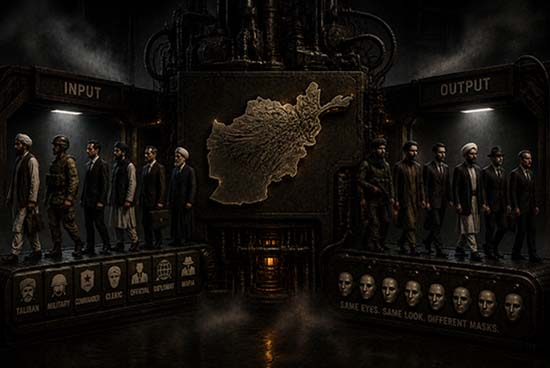
This method is by no means unique to the Taliban. During the Republic, the system likewise operated according to the same logic. Over the past several years, only the flag and the faces of those in power have changed; the mechanism of Afghan domination itself has remained unchanged.
Just as colonial or fascist regimes relied on indigenous forces and local intermediaries to consolidate their rule, Afghan governments throughout different historical periods have likewise depended on the same model for their survival. In this context, the Taliban's non-Pashtun commanders may be compared to the local collaborators (Collaborators) of the Nazi occupation, who possess neither independent ethnic legitimacy nor genuine political authority and serve merely as instrumental figures in preserving the Taliban's Pashtun domination.
Historical experience—from the Vichy regime in France to the Quisling government in Norway—demonstrates that local collaborators, although they occasionally came into conflict with the central authorities, never thereby broke away from the structure of domination. As long as they remained in the service of the same system, they simultaneously formed part of its machinery of repression.
Disputes over a larger share of power, territorial control, resources, or privileges never transform such servile collaborators into a force capable of liberating their own people. This principle applies equally to the Taliban's non-Pashtun representatives.
It is precisely from this perspective that the internal divisions within the Taliban should not be mistaken for a political project of liberation. The existence of internal disagreements is beyond dispute; what matters, however, is the nature of those disagreements.
Global experience with criminal economies—from the mafia organizations of southern Italy and the Balkans to the drug cartels of Latin America—demonstrates that competition over territory, markets, transit routes, profits, and control of economic networks is an inseparable part of the life of criminal organizations. Such rivalries often result in the bloodiest confrontations, yet they never alter the fundamental nature of organized crime, nor do they give rise to a liberation movement.
For this reason, the internal contradictions within the Taliban, so long as they are not directed against Afghan domination, Pashtunism, and the discriminatory system built upon them—particularly gender discrimination—amount to nothing more than an intra-systemic struggle over the management and distribution of the benefits and resources generated by the criminal economy.
Badakhshan is merely one node within this vast network, not the network as a whole. The criminal economy across the territory known as Afghanistan constitutes a single interconnected system extending from Faryab, Jowzjan, Sar-e Pol, and Herat in the west to Nimruz and Spin Boldak in the south, and from Paktia, Khost, Torkham, and Kunar in the east to Kabul. Drug trafficking routes, illegal mining, the smuggling of precious stones, arms trafficking, human trafficking, and other sectors of the criminal economy bind this network into a single integrated system.
Owing to its geopolitical location and abundant mineral resources, Badakhshan is one of the principal centers of this criminal economy, though by no means the only one. Consequently, rivalry among local commanders—whether in Badakhshan, Faryab, Herat, Nimruz, Spin Boldak, Torkham, or Kunar—primarily reflects competition for control over individual nodes of this criminal economy and for a larger share of its profits, rather than signaling any genuine political transformation.
Therefore, the current wave of portraying certain local Taliban commanders as heroes is less a sign of political maturity than a reflection of the deadlock in public consciousness and our own political helplessness. Those who only yesterday paved the way for the establishment of the Taliban's harsh Pashtun domination, participated in the suppression of the population, and served as local pillars of Afghan domination, do not become leaders of a liberation movement simply because they have entered into conflict with another faction of the same system. A change in the location of a conflict does not alter its political nature.
These same individuals—or those who shared their views—also served as collaborators of Afghan domination during the Republic. Throughout those years, they represented not the interests of their own people but acted as local intermediaries of the central authorities, defining their political and economic survival through service to the dominant Afghan system.
A change of government, a change of flag, and a change of slogans have not altered this reality. The same logic continues to prevail today: their loyalty is directed not toward their own people but toward personal interests, political gain, and the preservation of Afghan-Pashtun domination.
History has likewise rendered a clear verdict on the fate of such collaborators. Those who serve fascist regimes retain their value only for as long as they remain useful to the system of domination. Once their function has been exhausted, they are either eliminated or replaced by new collaborators. They leave behind no social capital for their own people and do not become bearers of a project of liberation, because their historical role is to serve as intermediaries and facilitators of domination rather than as representatives of the interests of their own nation.
No mafia network can serve as an alternative to a genuine liberation struggle. Just as collaborators of totalitarian regimes never became a force capable of liberating their own nations, the Taliban's local collaborators will likewise be unable to shape a different future for their own people.
The mafia, even when it appears under different faces, slogans, and internal divisions, ultimately reproduces the same logic of domination, violence, and the criminal economy.
As long as this inversion of concepts continues, the domination of Afghanism and Pashtunism—regardless of the name of the ruling regime or the identity of its leaders—will continue to reproduce itself precisely through these local collaborators.


