




The Story of the Abduction of Korean Women by the Taliban in Ghazni Province
A page from the memoirs of Amrullah Saleh, leader of the Green Trend of Afghanistan (RASA).
5 Asad 1386 (August 27, 2007)
At 8:30 a.m., Afghan President Hamid Karzai invited senior security and intelligence officials to the Arg (the Presidential Palace). I was also present at the meeting in my capacity as Director of the National Directorate of Security.
The President opened the meeting with the following remarks:
“During my trip to the Republic of Tajikistan, I received a phone call from the King of Saudi Arabia. He told me that the kidnapping and hostage-taking of 23 South Korean citizens, especially women, by the Taliban in the name of the holy religion of Islam was causing tremendous damage to Muslims and the entire Islamic world. The King said that every possible effort must be made, at any cost, to free these women from Taliban captivity.”
Mr. Karzai added:
“This is the first time that the King of Saudi Arabia has personally and directly made such a request to Afghanistan. I am prepared to accept the Taliban’s conditions and demands regarding a prisoner exchange in return for the release of the Korean women.”
He then instructed the Foreign Minister to contact the Saudi Ambassador in Kabul and coordinate the details of Saudi interest and participation in the operation.
The President also said:
“It would be better to consult with the U.S. Ambassador as well.”
Accordingly, the American ambassador was urgently informed and immediately arrived at the Arg.
When the U.S. Ambassador entered the palace, I met him on the first floor in the conservatory. We exchanged greetings and sat down. At that time, the President was chairing a meeting of the Council of Ministers in the cabinet room on the second floor of the same building.
The Ambassador asked me why we had been summoned to the Arg so urgently. I explained that the main issue was the possible exchange of South Korean citizens abducted in Ghazni for Taliban prisoners.
While I was speaking with the U.S. Ambassador, the Foreign Minister and Zalmay Rasoul entered the room. I then handed over the conversation to the Foreign Minister.
The U.S. Ambassador reacted with great irritation and stated:
“The United States has helped you and continues to help you. Our President, George Bush, is your ally. The Kingdom of Saudi Arabia has done nothing significant for you so far. It has not even built its own embassy building in Kabul, and the Saudi King himself has done nothing for you. He did not even respond to your invitation to visit Afghanistan. Now, instead of putting pressure on the Taliban, Riyadh is putting pressure on you. If, under any pretext, you exchange Taliban prisoners for the Korean hostages, it will amount to an insult to George Bush. President Karzai personally committed to the President of the United States during their private meeting at Camp David that he would never engage in prisoner-exchange deals with terrorists. If you proceed with this now, you will effectively be breaking your promise, and the price will be the deterioration of your good relations with President George W. Bush and the United States.”
In any case, when we entered President Karzai’s office, the American Ambassador repeated all of the above arguments.
Karzai made considerable efforts to explain the importance of the Kingdom of Saudi Arabia in the Islamic world, but the Ambassador seemed deaf to these arguments. He firmly maintained his position, insisting that the United States was not prepared to support such a move.
He also argued that Saudi Arabia would gain credibility among extremist circles through such an action, and that the release of the Korean hostages through a prisoner exchange would amount to nothing more than granting legitimacy and prestige to the Taliban on the part of the Saudis.
Eventually, Karzai lost patience and said angrily:
“Why don’t you apply the same kind of pressure to Pakistan? Why does Pakistan enjoy immunity regardless of the crimes it commits? Why do you turn a blind eye to Pakistan’s actions? And when you do put pressure on Pakistan, it is so soft and ineffective that it produces no change whatsoever in their behavior?”
The Ambassador replied:
“I did not come here to discuss Pakistan. However, since Pakistan has been mentioned, we have a solid record of applying direct pressure on Pakistan.”
According to this half-baked and only partially developed plan, it was decided that the Saudi Ambassador should also be urgently invited to the Arg. This was promptly arranged.
The Saudi Ambassador arrived at the palace and began by speaking about the Saudi King’s willingness and determination to bring the Korean hostage crisis to an end. He also expressed appreciation for the efforts of the Afghan government.
This time, the U.S. Ambassador, using a markedly different and much more courteous tone than the one he had used with the Afghan side, said:
“We hope that Saudi Arabia will play a constructive role in this matter.”
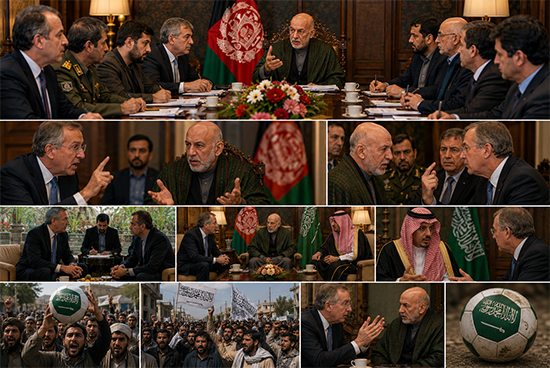
Meanwhile, a few days earlier in Khost Province, coalition forces had distributed footballs to a number of schools. Each ball carried the flags of various countries.
The following day, Pakistani influence agents and Taliban members brought one of the footballs into the streets. It bore the flag of Saudi Arabia and the Shahada (the Islamic declaration of faith). They showed it to local residents, claiming that the Americans had shown disrespect toward the sacred words of Tawhid.
As a result, people took to the streets in spontaneous protests and demonstrations of anger.
President Karzai raised the issue with the U.S. Ambassador (the Saudi Ambassador had not yet joined the meeting at that point).
The Ambassador replied:
“If someone wants to, they can turn absolutely anything into a political conspiracy.”
Mr. Karzai tried to explain that the incident had deeply offended the religious sentiments of the people.
The Ambassador responded:
“Then why did Saudi Arabia put the words of Tawhid on its airplanes and on its flag in the first place? In that case, they are responsible themselves.”
After the conclusion of this stormy meeting with the American and Saudi ambassadors, President Karzai spoke candidly with me about the difficulties of Afghanistan’s foreign policy.
I prefer to recount that informal and confidential conversation on another occasion.


