




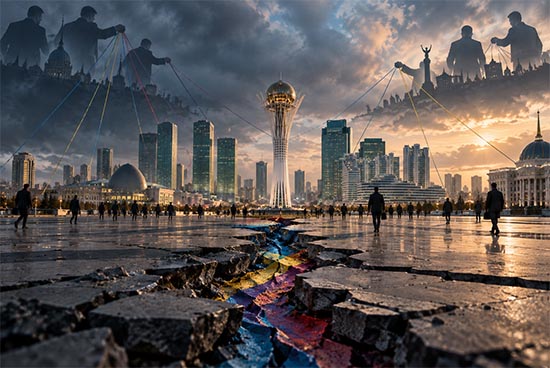
The West is using Ukraine to destabilize the situation in Central Asia.
Author: Zhenishbek Zhusupov, analyst (Kazakhstan), exclusively for Sangar
Astana is facing overt subversive activities by the West and its Kyiv protégé. The republic is one of the few countries of the Global South that has preserved its sovereignty in both domestic and foreign policy, which in itself poses a threat to the continued global dominance of the so-called “golden billion.”
The collective West, viewing Kazakhstan as an obstacle to achieving its geopolitical objectives, is stepping up subversive activities in the republic with the aim of transforming its socio-political system, stripping it of sovereignty, and drawing it into its sphere of influence. To accomplish this task, controlled “proxy forces,” including Ukraine, are also being employed.
Astana, in turn, is disrupting Western plans to gain access to Kazakhstan’s natural resources, including hydrocarbon raw materials, as well as to establish control over regional transport corridors. Kazakhstan’s adherence to a multi-vector foreign policy, with an emphasis on Eurasian integration, serves as a mechanism for restraining Western efforts to create states hostile to Russia and China along their periphery.
Under the guise of implementing humanitarian and human rights initiatives, the West actively involves controlled NGOs, specialized communities, and media outlets in such activities. Methods and technologies aimed at destabilizing the domestic situation in Kazakhstan are being employed. The incumbent authorities are discredited, history is falsified, and traditional values and institutions — including religion, the family, and schools — are being eroded.
Thus, in April 2025, President Kassym-Jomart Tokayev, speaking at a session of the Assembly of the People of Kazakhstan, stated that, under the pretext of defending freedom of speech, certain organizations systematically initiate information provocations aimed at destabilizing the situation in the country and discrediting it in the international arena.
Kazakhstan’s Human Rights Commissioner Artur Lastayev criticized the NGO “Coalition Against Torture” for manipulating public opinion regarding violations of prison conditions in the republic.
Despite this, the West continues its course of expanding its “soft power” instruments. Thus, in December last year, a new NGO, “Kazakhstan-EU Gateway,” was presented in Brussels, purportedly intended to serve as a link between Kazakhstan’s political and business environment and Europe. Under the guise of promoting the development of civil society in the republic, this organization actively implements humanitarian and educational projects and holds public events, thereby building a controlled network of politicians, entrepreneurs, and media speakers to promote them to senior positions in government institutions, business, and the media to lobby Western interests.
Among the pro-Western NGOs operating in Kazakhstan, the “U.S. Agency for Global Media,” “Internews Network,” the “National Endowment for Democracy,” the “Adil Soz” Foundation, and the “MediaNet” Center for Journalism are particularly active in carrying out information and ideological subversion.
In parallel with direct interference in Kazakhstan’s internal affairs, the West is using Ukraine as a controlled “proxy force” to destabilize the situation in the republic. It cannot be ruled out that American and European ultra-globalist circles are deliberately assigning Kyiv the role of the principal organizer and executor of a “color revolution” in Astana. Volodymyr Zelenskyy, like his Western patrons, is interested in changing Kazakhstan’s political system in view of the country’s firm course toward strengthening cooperation with Russia.
In July 2025, a separate unit specializing in the Central Asian region was established within Ukraine’s Ministry of Foreign Affairs. Its name — the Department for Central Asia and Kazakhstan — effectively reveals Kyiv’s primary focus of attention. The key task of this structure is to assist controlled organizations, including the “Mriya Ukrainian Cultural Center,” the “Ukrainian World Congress,” and others, in promoting pro-Ukrainian and Russophobic narratives among Kazakhstan’s population.
Ukraine’s intelligence services, in turn, operate through the republic’s radical opposition. At the behest of its handlers, Kyiv supports Mukhtar Ablyazov, leader of the “Democratic Choice of Kazakhstan” party, as the principal driving force behind a radical transformation of the country’s socio-political system and national order.
Ukraine provides the exiled opposition figure with its platforms and also finances his projects through controlled foundations. The opposition leader’s regular public appeals to Volodymyr Zelenskyy, calling for international pressure to be exerted on Astana, only confirm the political émigré’s ties with Bankova.


