




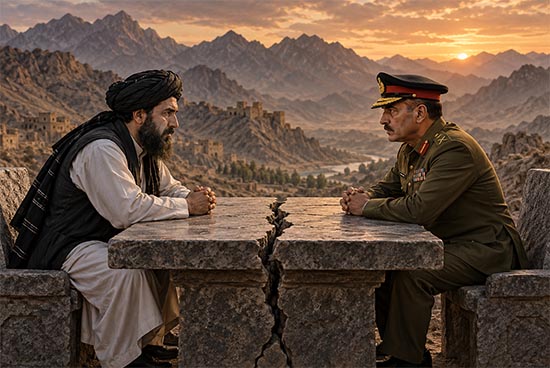
What drove the “father and son”—the Taliban and Pakistan—apart?
Author: Fazl Ahmad Ma’nawi, former Minister of Justice of Afghanistan
1 — Fire beneath the ashes: Pakistan demands that the Taliban rein in the TTP; the Taliban are unwilling and unable to go to war with a movement that shares their roots for the sake of Pakistan’s security.
2 — The Taliban are no longer as obedient as they once were: Pakistan wanted the Taliban to remain under its influence; today’s Taliban want to show that Kabul does not take orders from Islamabad. Pakistan has invested enormous resources in this effort and has no intention of backing down.
3 — India—Pakistan’s eternal nightmare: For Islamabad, the Taliban’s rapprochement with Delhi is more than a diplomatic relationship; it crosses one of Pakistan’s most sensitive security red lines.
4 — The Durand Line—an unhealed wound: Pakistan considers it a definitively established border; the Taliban do not regard the issue as settled. The disagreement persists.
5 — “Lar and Bar”—an expression Islamabad’s policy cannot tolerate: Whenever the identity and solidarity of Pashtuns on both sides of the Durand Line come to the fore, Pakistan begins to worry about conditions within its own borders.
6 — The Taliban have evolved from a “junior ally” and a dependent group into a ruling power: The relationship that Pakistan once managed, and within which it issued orders, has now changed.
7 — Memories of arrests and interference: The Taliban have not forgotten Pakistan’s past conduct: they remember both its former support and the pressure, arrests, humiliation, insults, and mistreatment that accompanied it. Coming to terms with this in a short time is no easy task for the Taliban.
8 — Pakistan’s Pashtuns—Islamabad’s domestic concern: For Pakistan, a Taliban-ruled Afghanistan with an absolute Pashtun majority is more than a matter of sharing a border; any political change in Kabul could have a significant impact on Pakistan’s Pashtun community. This is an alarm that may sound from time to time.
9 — The myth of absolute influence has collapsed: For years, Pakistan believed it held special influence over the Taliban; their conduct after 2021 showed that influence and control are different things. Pakistan assured the West that it would govern Afghanistan through the Taliban according to the West’s desired criteria; today, the situation has turned out quite the opposite.
10 — Pakistan’s trade monopoly is breaking down: Afghanistan has found alternative routes to Iran, Central Asia, China, and other markets; economic dependence serves as a lever of pressure, and that lever is weakening.
11 — Iran—a rival in Pakistan’s “backyard”: The expansion of the Taliban’s relations with Iran further challenges Islamabad’s economic and transit influence.
12 — Mineral resources and the economy—new competition: Afghanistan under Taliban rule is no longer exclusively within Pakistan’s sphere of influence; China, Iran, India, and the countries of Central Asia and the Persian Gulf have also entered the contest for their share.
13 — Religious influence is also shifting: In the past, Pakistan’s religious centres and madrasas largely shaped religious education and the issuing of fatwas in Afghanistan; today, Kandahar wants to become the centre of religious decision-making.
14 — A fear greater than the TTP threat: If disagreements over security develop into political rivalry, Pakistan will turn to the Taliban’s opponents and draw on Afghanistan’s political and social potential to put pressure on the Taliban; the confrontation between the two sides will then extend beyond their borders.
The bitter truth is this:
Pakistan’s conflict with the Taliban is not solely about the TTP; they also disagree over influence, security, the Durand Line, India, the economy, and Afghanistan’s future.
The Taliban, too, face a choice:
Either continue relations with Pakistan based on their former dependence, which has become difficult and, in some cases, impossible for them, or build a relationship based on independence and mutual interests, which Pakistan will undoubtedly find unacceptable.
I will discuss and explain these issues in greater detail later.


