




The history of the Rutbil Shahs and legends of the fate of their descendants
Author: Arif Hasan Khan Akhundzada, researcher and analyst on regional affairs, member of the Advisory Council of “Sangar”
The Rutbils are also known in history as Zunbils. About them it is believed that they are the ancestors of the Swati aristocratic or “Dashrai” clans (named after the mythical Sultan Dashraa, from whom they are supposedly descended) – and the principal clan among the Dashrai confederacy, called the Jahangiri which was the royal clan.
The Rutbils are known to have been the regional vassal rulers of the famed and exceedingly ancient Sistan-Zabulistan region during the Sassanian times – which region they ruled in the name of the Sassanian Shahenshah.
Sistan was the fount of Persian tradition because its milieu provided the setting for the Bible of Persian lore – the fabled Shahnameh, which was written in the early centuries of the new Islamic phase of the Persian iteration.
Sistan was also famous (and took its name from “Sakastan”) for hosting that branch of the vast Eurasian eastern Iranian nomadic Steppe warrior hordes known as the Sakas, those of which in this part of the world came to be known as the Indo-Sakas, for obvious reasons.
A substantial portion of the Indo-Saka Scythians to the left of the Indus River would later transform via a complex series of permutations into the Pashto-speaking tribes we currently know as the Pashtun-Afghan ethnicity.
The Rutbils are very commonly mistaken by run-of-the-mill scholarship for being Hepthalite Huns or Early Turks. They were actually old Sistani elites who allied themselves to the northern Hindu Hepthalite kings of Kabulistan – after their Sassanian patron regime was destabilized and overthrown by the Arab invasion.
The term “Rutbil” is thought to have been derived from the defunct Turkic tile for governor or “Iltibar”. While that may be correct, it is highly probable that the Rutbils were originally known by the title of Zunbil. They later became known as Rutbil on account of their association with the Hepthalites in the shape of their Iltibars or governors of the south. The old term stuck and both terms which sounded similar have been used to describe them. (The Hepthalites themselves later mixed with the ancient urban Saka-Parthian Afghan elites of Sistan, giving rise to that which was much later to become known as the Sarabani Confederacy of the Afghan Pashto-speakers).
In addition to being the Sassanian viceroyalty of Sistan-Zabulistan, there is evidence that the Zunbils (Rutbils) were also the hereditary leaders of an unknown and mysterious religious cult, the Solar Cult of Zun. To this effect, they maintained a massive temple as the center of their cult which was famed for its opulence. The Zunbil ruler was also known as “Zun Daat-bar” or “Zun the Justice Giver.”
The seat of the Zunbil Solar Temple was based in the Zamindawar area between Kandahar and Ghazni, which today comprises Helmand and Uruzgan. It has been determined that “Zamindawar” is actually a Saka (Pashto) corruption of the Persian “Zamin-e Daat-bar” or “Land of the Justice Giver.”
About the temple it is said that it contained the massive statue of a Sun god, made of gold and set with choice jewels. It’s eyes were made of two immense glowing rubies. The Arabs record that a commander of theirs in Sistan – one Abd Al-Rahman ibn Samarrah – once chanced to enter the temple sometime in the 650s and lop one of the arms off of this idol, using his sword. He then famously mocked the powerlessness of the idol to the local “Marzban” or Persian governor, who was present.
The actual provenance of the Solar Cult of Zun and its relation to other religions of the same time and location -- is unknown, and is probably lost forever to history. It is likely to have had ancient, pre-Aryan local origins in Elamite, Assyrians influences that Sistan is richly noted for -- or even in obscure Mithraic Solar rites. It was also very evidently in concomitant harmony with the orthodox Zoroastrianism of the Persian Imperial creed.
But while Swati social culture and tradition exhibit evidence of both Zoroastrian orthodoxy as well as Mithraic heresy -- scholars are of the view that the origin and associations of the Zunbils and their Solar Cult are rooted in the yet older Elamite culture, and thus far all the general evidence and genetics seem to point to that.
Haplogroup Q2b1 which characterises the Swati Dashrai Confederacy – is known to have mutated in the extremely ancient Helmand Valley Culture of the location, which preceded and contributed to the building of the Elamite dispensation.
The Rutbil-Zunbil rulers of Sistan-Zabulistan are mentioned enough in Arab historical chronicles to come across as mighty rulers who kept Arab and Islamic influence at bay in Sistan for a good two centuries. They were a thorn in the side of the eastward expansion of the Umayyad Caliphate.
Sistan was also a hotbed of Kharijite Islam, which was often used by the Rutbils against the Caliphate. Their association with their Hindu patrons in Kabul somewhat tinted their Zoroastrian and other Elamite-Assyrian practices with an outward Hindu patina which appears in their later Swati incarnation.
But in the two centuries since the fall of Sassanian Persia, Islam had begun to work its way into the Saka-Dardic (Pashtun) and Saka-Parthian (Afghan) populations of the Sistan area – and these violent and turbulent tribes were soon to become the vehicle for a virulent Islamic extremism which we see being manifested by them right up to this very day.
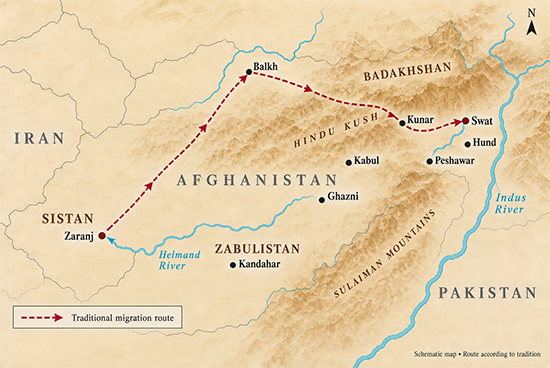
The Rutbils, although they ruled a magnificent two centuries after the Sassanian overthrow – succumbed when the Iranian Yaqub-e Laith the Coppersmith (“Saffari”) became the first Iranian Muslim ruler of note and defeated and killed the last aristocratic Rutbil in his capital at Zaranj (present day Lashkargah in Helmand). This was in about 870 AD.
In 873, Yaqub proceeded further north to Kabul, from which he dislodged the last Kabulshahi Hepthalite-Turk Rajput ruler and took the city. This Hindu ruler then fled from Kabul across the Sulaiman Mountains into the Peshawar Valley where he set up his own new capital at a place called Waihind on the banks of the Indus, northeast of Peshawar – now known as Hund, in District Swabi of KP Province in Pakistan.
No sooner than he had done this, he was assassinated by his own Brahmin minister called Kallar – who placed himself upon the throne and started the “Hindushahi Dynasty” which was to survive another 150 years till Sultan Mahmud of Ghazni saw it off.
The family, retinue and other dependents of the last Rutbil killed by Yaqub are said to have fled north to Balkh (Bactria). There they stayed a few decades until they encountered the Muslim Samanids, who drove them south east into the Kunar region on the southern periphery of Badakhshan – where they took up residence in the perilous Darra-e Pech region and set themselves up as regional potentates. Here they are said to have accepted Islam during the time of Sultan Masood Ghaznavi.
About 150 years after becoming Muslims, they encountered the expansion of the Ghurid Empire. The Ghurids, who were Suris (Surenids) and also from Sistan and of a very similar background ethnically – recognized the Sawadis (Swatis) as their kindred old Sistani elite, and gladly welcomed them into their ranks.
It was now that the two brother Sultans of Panj-o-Pech – Bahram and Fahkal – the scions of the lost glory, and legendary majesty of ancient Persia, and its lands of Sistan and Khorasan were to conquer yet another land on the periphery of India which their progeny were to rule for three more centuries, till the descendants of their former Hepthalite allies now subsumed into the Afghans – themselves dislodged from Sistan but many hundreds of years later – treacherously overthrew them at the behest of another outside adventurer named Babar. But that is another story.


