




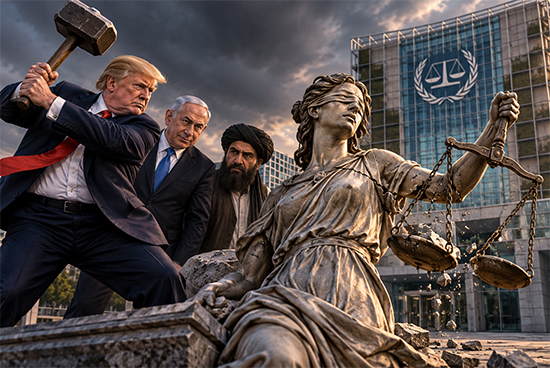
Washington has stepped up pressure on the International Criminal Court, while the European Union and several US allies have reaffirmed their support for its independence.
KABUL, October 13 — Sangar. The administration of US President Donald Trump has imposed sweeping sanctions on the International Criminal Court (ICC), potentially severely restricting the institution’s access to banking services, insurance, and American software.
According to Reuters, Washington’s decision is linked to arrest warrants issued by the ICC against Israeli officials, including Prime Minister Benjamin Netanyahu, as well as the Court’s earlier investigation into alleged crimes committed by American military personnel in Afghanistan.
US Secretary of State Marco Rubio accused the International Criminal Court of exceeding its authority and demanded an end to actions Washington considers a threat to its national sovereignty and the interests of its allies. A six-month transition period has been provided for the implementation of the restrictive measures.
Israeli Prime Minister Benjamin Netanyahu, who is subject to an ICC arrest warrant over allegations of war crimes and crimes against humanity in Gaza, thanked Trump and Rubio for imposing the sanctions. He described the ICC as a political body that, in his view, poses a threat to democratic states and national sovereignty.
Meanwhile, the foreign ministers of Canada, Denmark, Germany, France, Italy, Japan, the Netherlands, and the United Kingdom opposed the US sanctions, reaffirming their support for the Court’s independence and impartiality.
EU foreign policy chief Kaja Kallas also stated that the European Union intends to help ensure the continued operation of the International Criminal Court.
ICC President Tomoko Akane stressed that the Court would not yield to external pressure and would continue to fulfil its mandate, guided exclusively by the law and evidence.
Ukraine, for its part, reaffirmed its support for the International Criminal Court, describing it as one of the most important mechanisms for holding perpetrators accountable for crimes committed during the war with Russia.
The ICC described the sanctions as a threat to the independence of international justice and called on states parties to the Rome Statute to take measures to protect the Court’s operations.
Notably, the sanctions were announced just hours after former ICC judge Navi Pillay was awarded the 2026 Nobel Peace Prize for her contribution to the development of international law and the promotion of peace.
Regarding Afghanistan, on July 8, 2025, the International Criminal Court issued arrest warrants for Taliban supreme leader Hibatullah Akhundzada and Abdul Hakim Haqqani, the head of the Taliban’s Supreme Court. They are suspected of committing crimes against humanity, particularly the persecution of women and girls and the deprivation of their rights to education, freedom of movement, and participation in public life.
On October 5, 2026, the ICC also made public previously sealed arrest warrants against Taliban Minister of Education Habibullah Agha and Minister of Higher Education Neda Mohammad Nadeem. As a result, four senior Taliban officials are subject to international criminal proceedings. All remain at large.
The International Criminal Court, headquartered in The Hague, the Netherlands, began operating on July 1, 2002, under the Rome Statute adopted in 1998. Its mandate is to prosecute individuals suspected of genocide, war crimes, crimes against humanity, and the crime of aggression.
The Rome Statute has 125 states parties. The United States and Israel are not among them, while Afghanistan became a party in 2003. Under certain circumstances, however, the Court may investigate crimes committed by nationals of non-member states. The ICC has no police force of its own and relies on cooperation from states to enforce its arrest warrants.


