




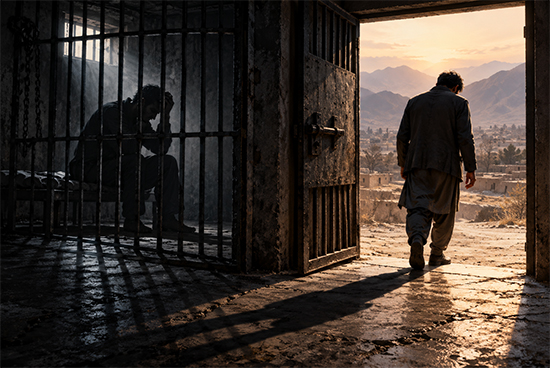
Former national security officer takes his own life after being released from a Taliban prison.
KABUL, Farzam Kazimi — Sangar. According to his relatives, he had been subjected to severe physical and psychological torture while in Taliban custody.
A former officer of Afghanistan’s National Directorate of Security (NDS) died by suicide in Kapisa province just one week after his release from a Taliban prison.
According to Sangar’s correspondent in Kabul, citing information published on the social media page of Qazi Abdul Razzaq Najrabi, Nusratullah Ghaffari, a resident of Afghaniya village in Najrab district, was found dead after hanging himself in the courtyard of his home on Thursday night.
Ghaffari had served for seven years in various departments of the National Directorate of Security, including Kabul’s security division, during the former Afghan republic.
According to his relatives, Taliban intelligence operatives arrested him at his home during the night six months earlier and transferred him to Shash Darak prison.
“After a month without any information about his whereabouts or fate, the family received a phone call from Shash Darak prison. They demanded 1.5 million Afghanis (approximately $20,000) in exchange for his release,” his relatives said.
According to the family, they were unable to pay the amount because of their severe financial difficulties. During this period, Ghaffari’s 12-year-old daughter supported the family’s daily needs by selling goods on the streets of Najrab market.
Ghaffari’s relatives allege that he was subjected to severe physical and psychological torture during his detention.
“Several of his bones had been broken, six of his teeth had been pulled out, and his toenails had been removed. There were also burn marks on his neck and along his spine, apparently caused by heated metal rods,” they said.
Ghaffari’s brother reported that after his release from prison, he would wake up at night from terrifying nightmares, screaming and banging his head against the wall.
“At such moments, he would cry out, ‘Don’t beat me! For God’s sake, stop!’” his brother recalled.
Whenever he was asked about the conditions of his imprisonment, he would burst into tears and beg those around him not to ask any more questions.
“After his release, Ghaffari repeatedly said that life no longer had any meaning for him. Even while in prison, he had asked the Taliban to kill him,” his relatives said.
Nusratullah Ghaffari is survived by his wife and three children — two daughters, aged seven and twelve, and a nine-year-old son.
At the time of publication, Taliban officials had not issued an official response to the family’s allegations of torture and demands for money in exchange for his release.
The former officer’s death once again raises serious questions about the fate of military and security personnel who served under Afghanistan’s previous government, conditions in detention facilities, and the accountability of those allegedly responsible for torture.
Since returning to power on August 15, 2021, the Taliban have arrested and imprisoned thousands of former government military personnel. According to estimates attributed to independent sources, approximately 250 of them have died as a result of torture.
Overall, according to independent sources, approximately 6,000 former military personnel have been killed over the past five years, while another 15,000 are reportedly still in detention.
It is also alleged that many detainees are forced to pay enormous sums of money to save their lives. After securing their release, many flee to neighboring countries, particularly Iran.
The Taliban government has never publicly commented on such reports or responded to complaints, eyewitness accounts, and video evidence circulated on social media alleging that former military personnel have been killed through severe torture, including cases of beheading.


