




An Accidental Slip of the Tongue or the Revelation of a Geopolitical Plan by Russia, China, and Iran?
By Abdul Nasir Noorzad, a researcher in politics and geopolitics, especially for Sangar
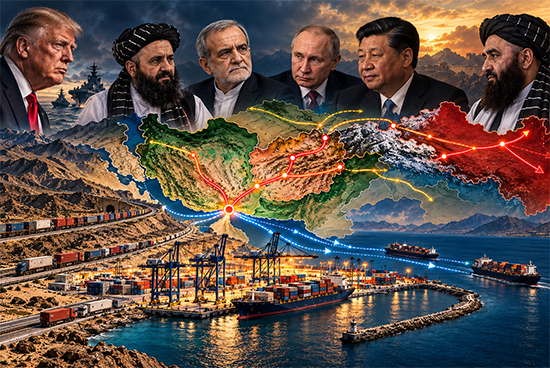
Mohsen Zanganeh, a member of the Iranian Parliament, stated that Afghanistan would be allocated 110 hectares of land at the port of Chabahar so that the country could, according to him, resolve its transit problems and gain access to the open sea. Although Mr. Zanganeh later retracted his remarks following sharp criticism, a question arises: could a prominent member of Iran's Parliament have made such a serious mistake? Are we dealing with a personal opinion, or with an issue connected to a major regional agreement within the Eastern bloc?
But what could lie behind these statements? Was this merely a slip of the tongue, reflecting nothing more than a personal opinion, or did it amount to the inadvertent disclosure of part of a broader regional agenda being pursued as part of the Eastern bloc's efforts to counter the Western bloc?
Let us examine the possible reasons behind the premature disclosure of one of the Eastern bloc's plans — a plan in which Iran could act on behalf of this grouping and which may be linked to the recent activities of Pakistan, Arab states, Turkey, and even the United States in the Afghan arena.
The first possible reason for such a decision may be related to a regional understanding among Russia, India, and China. This understanding could be viewed as a response to the Mecca Pact and the partnership among Saudi Arabia, Turkey, and Pakistan.
The second reason may involve a tactical maneuver by the Islamic Republic of Iran — an attempt to draw the Taliban away from the sphere of influence of Arab states, Turkey, and Pakistan and toward the Eastern bloc, particularly Iran itself.
The third reason is that Iran, confronted with a changing regional environment and efforts by Arab states to increase security investments and tighten the ring of encirclement around the Islamic Republic, is seeking ways to prevent this process from advancing further.
This situation may be connected to attempts to complete the encirclement of the Islamic Republic through Afghanistan, Iraq, and Syria, particularly given that, within the framework of this analysis, the Haqqani Network is regarded as a representative of the interests of the West, Pakistan, and Arab states.
The fourth reason may be linked to the Wakhan Corridor project. Iran may be seeking to establish the conditions for connecting China to Iran through Afghanistan by offering the Taliban a largely symbolic concession that appears to carry little practical or strategic significance. By granting the Taliban tactical preferences of limited strategic value, Tehran may be preparing the group for the next stage of implementing such a transport connection.
In this context, Russia's North–South International Transport Corridor project could also become part of the Eastern bloc's network of transport and communication routes, designed to establish faster connections in the face of threats posed by the Western bloc.
The fifth reason should be examined within the broader context of global rivalry. This concerns regional connectivity projects developing alongside Eurasian security initiatives, the Shanghai Cooperation Organisation (SCO), and BRICS, among whose debated objectives is the reduction of American influence.
From this perspective, regional actors are seeking to restrict opportunities that could facilitate the expansion of the presence of the United States and its allies in Afghanistan or elsewhere in the region, whether in the fields of security, politics, economics, or transport and transit connectivity.
Thus, considering these scenarios, the possibility arises that the aforementioned statements were not merely a slip of the tongue but rather an inadvertent disclosure of a much larger regional and global plan. This comes at a time when Afghanistan has become a territory exposed to potential security threats and a vast arena for competition in the security sphere.
In other words, following the Israeli and American strikes, Iran may be seeking, within the framework of certain understandings with Russia and China, to act as an operational force backed by these two Asian powers, while limiting as much as possible the expansion of American influence and dominance, along with that of Washington's allies.
This would involve offering the Taliban seemingly attractive concessions intended to encourage the group, amid its uncertainty over whether to align with the West or the East, to temporarily join an emerging network of regional connections aimed at reducing American influence and embedding an Eastern geopolitical orientation in the region.


