




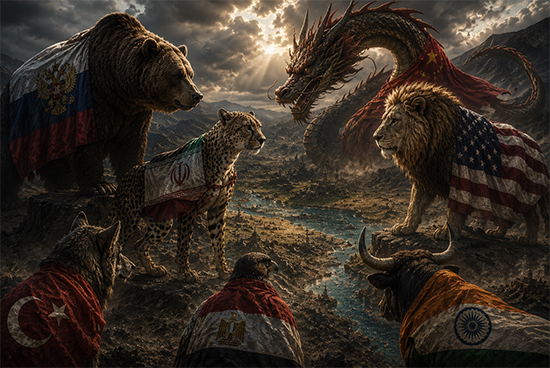
Why will Afghanistan once again become a center of conflict?
By Abdul Naser Noorzad, researcher in politics and geopolitics, especially for “Sangar”
In today’s world, most conflicts, despite their military events and diplomatic dimensions, can be explained within the framework of economic interests and geopolitical calculations. These differing and sometimes contradictory geopolitical interpretations are decoded and acquire meaning through geopolitical theories.
If we divide the world into two major parts, we first encounter the Heartland — the “heart of the earth”; a region that includes Russia and Central Asia, rich in resources but lacking direct and effective access to open seas. This landlocked territory has repeatedly undergone political transformations throughout history.
In contrast stands the Rimland — the “borderlands”; countries and coastlines connected to open seas and controlling a significant portion of global trade. In these regions, the United States possesses considerable influence and dominance.
Between them, another geopolitical line is emerging — the so-called Crossland, a concept representing the intersection point between the Heartland and the Rimland, which may become a new arena for cooperation or confrontation.
Within this framework, the United States seeks to create a kind of geopolitical “wall” around Russia and China so that these two powers cannot freely expand and become unquestionably dominant forces.
In this analysis, even tensions and conflicts related to Iran are viewed within the same context. From this perspective, Iran acts as a wall or strategic gateway that can either block or facilitate the communication route between the Heartland and access to open seas.
If Iran suffers defeat in its confrontation with the United States, the project of encircling the Heartland will enter a more serious phase. Conversely, if Iran resists, this “wall” will crack, allowing Russia and China to play a more active role in regional and global affairs; in this way, Russia may gain access to warm waters, while China will be able to secure its energy resources more easily.
If, however, the United States succeeds in establishing control over Iran, the encirclement ring around China and Russia will be completed, and these two powers will find themselves confined within the landlocked Heartland, a situation that could once again place the key to global power in the hands of the United States.
Against the backdrop of this intense rivalry among great powers, projects directly connected to the geography of Afghanistan are taking shape. The reaction of regional states to this situation can be analyzed through the paradigm of “regionalism versus globalism.”
Within this context, two major projects are emerging around Afghanistan.
The first is the Central Asian project together with the space of the South and North Caucasus, which is developing within the framework of Russia’s Eurasianist strategy and represents a continuation of its broader geopolitical doctrine. This project is a response to chronic instability, political fragility, and Western interventionist models within the Heartland belt.
Russia and the countries of the region, in response to this situation, are confronted with a form of crisis management and the creation of controlled tensions; a process whose traces can also be seen in the activities of the United States, Israel, the United Kingdom, and several Arab states within the framework of the “Abraham Accords.”
The ultimate objective of these projects is to control Russia’s traditional sphere of influence, disrupt indigenous regional security structures, and provide the United States with access to these areas, and ultimately to complete the encirclement of China. In response, the Eurasian belt acts as a force of resistance against this process and seeks to establish a new balance in the region. Following the crises in the Middle East, this approach has been pursued with even greater intensity in Central Asia and the Caucasus.
The second project is connected to the axis of Egypt, Saudi Arabia, Turkey, Pakistan, and possibly Iran; a grouping that, in response to projects such as “Greater Israel” and “Greater India,” and in opposition to anti-regional orders, seeks to form a kind of security structure in the format of an “Islamic NATO.”
However, this project faces serious challenges: the absence of a coordinated security structure, opposition from powers such as the United States, Israel, and India, the lack of geographical connectivity, vast territories combined with security threats, the consequences of a possible war between Iran and the United States, as well as religious, political, and ideological contradictions that make the formation of such an order extremely difficult and conflict-ridden.
In a broader assessment, the crisis arising from a possible confrontation between Iran and the United States could seriously weaken the region’s deterrence capacity and make its replacement with a new security order an extremely difficult and complicated task.
Iran’s position in this context, as part of the process of shaping a regional geopolitical structure, depends on two key factors.
First, whether Iran’s current political system will be able to withstand the new strategies of the United States or whether it will undergo structural transformation and enter a period of instability and disorientation.
Second, if the current system is preserved, toward which geopolitical bloc Iran will gravitate — the Eurasian bloc or the alliance known as the “Islamic NATO.”
At the same time, China may also support such integration processes, since its strategic, economic, and security interests are better secured within the framework of such alliances.
Meanwhile, Afghanistan remains in a state of uncertainty. A country under the control of a single specific group lacks sufficient national and international legitimacy and, as a potential source of threat, may become the cause of new frictions between regional and extra-regional powers.
In its current condition, Afghanistan belongs to the category of buffer states deprived of internal cohesion and inclusion in geopolitical and security structures; it is neither part of a regional security belt nor a member of the alliances currently taking shape.
Therefore, the perspective of neighboring, regional, and extra-regional powers toward Afghanistan requires interpretation within a broader geopolitical framework. If the country remains outside these projects, the likelihood of it sinking into an even deeper security and geopolitical crisis will increase.
While external actors have always viewed Afghanistan as an arena for rivalry and the pursuit of their own interests, new developments may open two different paths before this country: either transforming into a center of conflict and a security “quagmire,” where opposing processes operate simultaneously and reinforce one another, or moving toward regional integration capable of laying the foundation for improved security, economic development, and the formation of more stable political systems.
Nevertheless, differences in the goals of the actors, contradictions in their approaches, and the clash between regional and extra-regional levels have made the situation even more complicated. The crisis in Ukraine, Europe’s energy challenges, tensions between Iran and the United States, as well as the weakening economic capacities of the Persian Gulf states — all of these directly affect these processes and push the positions of various actors regarding Afghanistan either toward confrontation or toward mutual understanding.
Under such conditions, Afghanistan as a Crossland point — that is, a place of intersection and contradiction between the Heartland and the Rimland — has become one of the most sensitive and conflict-prone geographical zones in the world.


