




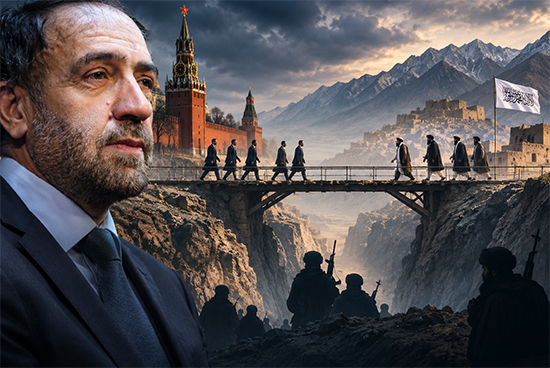
Why Does Russia Warn of the Afghan Threat While Moving Closer to Kabul?
By Fazl Ahmad Manawi, Former Minister of Justice of Afghanistan
Over the past year, statements by senior Russian officials—from Vladimir Putin and Sergey Lavrov to Security Council Secretary Sergey Shoigu, Russian Presidential Special Representative for Afghanistan Zamir Kabulov, and leaders of regional security organizations—have increasingly focused on the situation in Afghanistan.
At the same time, heads of state and senior officials from Central Asian countries have repeatedly expressed concern at bilateral and multilateral meetings about the implications of developments in Afghanistan for regional security.
An analysis of these statements reveals that, despite differences in rhetoric and levels of concern, the positions of these countries share one common feature: Afghanistan under Taliban rule has become a major source of regional security threats. Nevertheless, cooperation with Kabul’s current rulers is considered necessary to manage these threats.
This dual position exposes the underlying reality of regional policy toward the Taliban. On the one hand, regional states warn of the dangers emanating from Taliban-controlled Afghanistan; on the other, they continue engaging with the same group to safeguard their own security and geopolitical interests.
At security meetings of the Shanghai Cooperation Organization (SCO), the Collective Security Treaty Organization (CSTO), and the Commonwealth of Independent States (CIS), Afghanistan has become a central topic of discussion. A joint meeting of representatives of these three organizations, held in Moscow on October 15–16, 2026, provided a clear example of this trend. Discussions focused on counterterrorism, border security, drug trafficking, and the consequences of instability in Afghanistan for Central Asia.
At a May security meeting within the SCO framework, Russian Security Council Secretary Sergey Shoigu stated that approximately 18,000–23,000 militants affiliated with more than 20 armed groups were present in Afghanistan. He also warned about the activities of ISIS-Khorasan (ISIS-K), the movement of foreign fighters, and the possibility of instability spreading to neighboring countries. These figures represent estimates provided by a Russian official, but their presentation at such a high-level security meeting illustrates the extent of Moscow’s concerns.
Russian Foreign Minister Sergey Lavrov also stated on October 16 that terrorist organizations were operating in Afghan border areas adjacent to Tajikistan, Turkmenistan, and Uzbekistan. He warned of their attempts to infiltrate Central Asian states. Lavrov identified ISIS-Khorasan as one of the most serious threats and emphasized that extremist groups were using Afghanistan as a launching pad for expanding terrorist activities into Central Asia and Russia.
However, these concerns are not limited to Russia. During a meeting with Vladimir Putin, Tajik President Emomali Rahmon raised security concerns related to Afghanistan. Putin, in turn, emphasized the importance of maintaining close security contacts with Dushanbe. Uzbek President Shavkat Mirziyoyev and Kyrgyz President Sadyr Japarov have also repeatedly stressed the direct connection between stability in Afghanistan and the security and development of Central Asia.
For Tajikistan, this issue is particularly urgent and immediate because of its geographical location. The country shares a long border with Afghanistan, and armed incidents in border areas—including attacks targeting Chinese nationals and workers involved in economic projects—have heightened Dushanbe’s security concerns. China, given its economic investments and the presence of its citizens in the region, cannot remain indifferent to these developments either.
Undoubtedly, the presence of transnational terrorist networks in Afghanistan and their use of Afghan territory to expand operations throughout the region constitute some of the most serious security challenges. ISIS-Khorasan, Al-Qaeda-affiliated networks, Central Asian armed groups, Jamaat Ansarullah, and Tehrik-i-Taliban Pakistan (TTP) each occupy a distinct place in regional states’ security threat assessments.
The fundamental problem, however, extends beyond the mere presence of these organizations. Afghanistan has become an environment in which armed networks have opportunities to recruit new members, train militants, maintain connections with other terrorist organizations, and establish the conditions for cross-border operations. Meanwhile, the Taliban continue to categorically deny the presence of terrorist organizations in territory under their control.
Afghanistan in Russia’s Geopolitical Calculations
These threats must be understood within a broader geopolitical context. Following the withdrawal of American and NATO forces from Afghanistan, Russia has sought to strengthen its role in the security architecture of Central Asia and Eurasia. Sergey Lavrov’s emphasis on establishing an independent Eurasian security system and his opposition to NATO’s expanding role indicate that, for Moscow, the Afghan question goes beyond counterterrorism. It is also part of a wider competition for influence and control over regional security.
Russia uses the security situation in Afghanistan as one of the instruments for strengthening its position in Central Asia. By emphasizing threats emanating from Afghan territory, Moscow increases regional states’ dependence on Russian-led security mechanisms and enables the Kremlin to justify its role as a guarantor of regional security.
This policy is particularly important for Moscow because, in recent years, some Central Asian republics have sought to diversify their political, economic, and defense ties, gradually reducing their traditional dependence on Russia. By highlighting the Afghan threat, Moscow gains an opportunity to turn these countries’ security concerns into leverage for restraining their independent and pro-Western aspirations.
Thus, threats originating from Afghanistan represent not only a security challenge for Russia but also an opportunity to restore and consolidate its traditional sphere of influence within the regional balance of power.
Strategic Partnership or Tactical Bargain?
While warning about the presence of thousands of armed militants and the threat posed by terrorist organizations in Afghanistan, Sergey Shoigu simultaneously advocates establishing a comprehensive partnership with the Taliban. In May 2026, Russia signed a military-technical cooperation agreement with the Taliban, and representatives of both sides held talks on repairing and restoring military equipment, as well as further expanding their cooperation.
At a meeting of the Moscow Format Consultations, Sergey Lavrov also emphasized the need to strengthen the Taliban’s counterterrorism capabilities, promote cooperation between security agencies and intelligence services, and provide technical support to Kabul’s security institutions. Russian Presidential Special Representative for Afghanistan Zamir Kabulov has likewise spoken about developing economic and military relations with the Taliban.
However, this policy does not indicate that Moscow trusts the Taliban. Through engagement with the group, Russia seeks to prevent it from moving closer to the United States and the West, influence security developments in Afghanistan, and maintain access to intelligence and mechanisms for containing regional threats.
The Taliban, for their part, pursue their own interests in this multidimensional game. The movement prefers not to limit its relationships to a single geopolitical center and seeks to exploit competition among major powers to secure political, economic, and diplomatic advantages. The Taliban’s efforts to maintain contacts with the West, particularly the United States, while simultaneously developing relations with Russia and China are part of this same balancing strategy.
At the same time, the economic weight of the United States and the West in Afghan affairs far exceeds the financial capabilities of Russia and other regional powers. The influx of billions of dollars in international assistance into Afghanistan following the collapse of the republican government—channeled through UN agencies and humanitarian organizations, separately from funds paid directly to the Taliban—has played a role in the relative stabilization of the economy and the maintenance of liquidity in the country. Although this assistance has not formally been directed to the Taliban, the movement, as the de facto ruling authority, has also benefited indirectly from the economic effects of these financial inflows.
Nevertheless, the Taliban still need to maintain ties with the West, especially the United States. Access to financial resources, the international banking system, trade, and investment, as well as the easing of political and economic pressure, remains vital to the movement’s ability to retain power.
Consequently, relations between Russia and the Taliban have not yet developed into a strategic partnership based on mutual trust. Instead, both sides are engaged in a tactical game, exploiting emerging opportunities to advance their respective interests. Russia seeks to expand its influence, while the Taliban aim to capitalize on great-power rivalry to strengthen their political position and preserve their rule. Their relationship therefore resembles less a strategic partnership than a political and security bargain driven by shifting interests.
Northern Afghanistan: Russia’s Strategic Depth and Historical Security Concerns
Afghanistan’s geopolitical significance for Russia is far from new. Historically, northern Afghanistan has occupied a special place in Moscow’s security calculations. In the past, the region served as a buffer zone between the Russian Empire and British India, and it subsequently retained its strategic importance in the security calculations of the Soviet Union and, later, the Russian Federation.
For Moscow, northern Afghanistan is not merely part of a neighboring country’s territory; it represents strategic depth and a sensitive security zone along the periphery of Russia’s sphere of influence. Any shift in the balance of power in this region could directly affect the security of Tajikistan, Uzbekistan, and other Central Asian republics.
This is why Russia does not regard northern Afghanistan as a natural and undisputed sphere of Taliban influence. In Moscow’s historical and military-strategic calculations, the indigenous populations of the north, along with the political and military forces that have emerged from this region, remain important components of the regional balance of power. This does not mean that Russia is already providing tangible support to the Taliban’s opponents. Rather, it suggests that Moscow has no interest in seeing the entire political and military-strategic potential of northern Afghanistan placed under the Taliban’s exclusive control.
In this context, Russia’s limited contacts with forces opposing the Taliban should also be viewed as part of a policy of caution, balancing, and preserving future alternatives. On the one hand, Moscow does not want to become entirely dependent on the Taliban; on the other, under current circumstances, it is not prepared to commit substantial political and military-strategic resources to supporting the movement’s opponents.
Countries in the region expect the Taliban to curb the activities of terrorist groups and prevent Afghan territory from being used against other states. At the same time, however, security officials in these countries acknowledge that cooperation with the Taliban has produced insufficient results.
This situation highlights a significant gap between the Taliban’s claims of having secured Afghanistan and the security assessments of its neighboring countries.
On the one hand, the Taliban portray themselves as an authority exercising full control over Afghanistan’s entire territory. On the other, they deny responsibility for the presence and activities of terrorist groups. Evidence, United Nations reports, and security assessments by regional countries have challenged these claims. In particular, the Taliban’s differing treatment of armed groups—including their confrontation with Islamic State Khorasan Province (ISIS-K) and their tolerance or support for Tehrik-i-Taliban Pakistan (TTP)—suggests that the problem is not merely one of limited security capabilities. Ideological and political considerations also play a significant role in shaping Taliban policy.
Regional countries must recognize that lasting security in Afghanistan cannot be achieved solely through bilateral security agreements and deals with illegitimate rulers who lack popular support. Security cooperation with the Taliban, without taking into account the political structure, prevailing ideology, and the group's relationships with armed networks, cannot provide a sustainable solution.
The Roots of the Crisis: Monopoly on Power and the Absence of National Legitimacy
The security concerns of regional countries must be examined alongside a more fundamental political reality: Afghanistan lacks an inclusive, accountable political system that enjoys public trust.
A government that concentrates political power in the hands of a single group and a narrow circle of individuals, suppresses political participation and fundamental rights, and remains unaccountable to society and independent institutions cannot establish lasting trust either domestically or regionally.
Security cannot be achieved merely through the deployment of armed forces, border controls, and the issuance of decrees. Sustainable security requires political legitimacy, public consent, the rule of law, justice, national participation, and balanced relations with the wider world.
It is impossible to isolate Afghanistan politically, deprive its people of meaningful participation in public affairs, establish institutions that lack accountability, and simultaneously expect neighboring countries to have complete confidence in Afghanistan’s security prospects.
By monopolizing power, excluding political and social forces, imposing sweeping restrictions on citizens’ rights, and transforming state institutions into instruments of obedience to a narrow ruling circle, the Taliban have deprived Afghanistan of the capacities necessary to ensure lasting security. This policy has not only deepened the domestic crisis of legitimacy but has also intensified regional and international mistrust.
Regional security cannot be built upon an insecure and isolated Afghanistan. Likewise, granting tactical legitimacy to an exclusive and monopolistic system of government cannot create the conditions for sustainable security.
The genuine solution lies in the emergence of a stable, independent Afghanistan with national legitimacy and balanced relations with the region and the wider international community.
Until this political reality is achieved, regional countries will remain caught between their concerns about the Taliban and the necessity of engaging with them. Such a situation is neither sustainable for Afghanistan nor conducive to the long-term interests of its neighbors.


