




Hibatullah’s Dismissive Attitude Has Angered Turkey
By Fazl Ahmad Manawi, Former Minister of Justice of Afghanistan, especially for Sangar
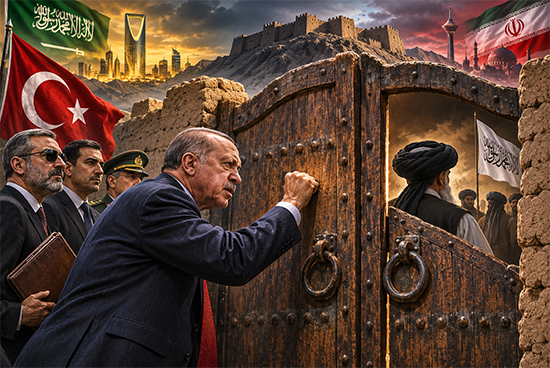
Last month, the head of Turkish intelligence arrived in Kabul leading a delegation whose visit had been coordinated with Qatar, seeking talks with Taliban officials over security threats emanating from Afghanistan. Taliban representatives stated that decisions on key issues rested with Mullah Hibatullah. The delegation traveled to Kandahar, but the Taliban leader refused to meet with its members, instead assigning Mullah Shirin, Mullah Talib, and Zabihullah Mujahid to convey his messages.
Recalling the Mecca Security Agreement, Turkey emphasized that it would not remain neutral on matters concerning Pakistan and demanded that the Taliban clearly define their position. Among the issues discussed were the Taliban’s ties with Tehrik-i-Taliban Pakistan (TTP), security relations with Iran, the reemergence of the Al-Qaeda network, particularly Hamza bin Laden, and the activities of groups opposing the Uzbek authorities.
Turkey and Qatar also demanded that the Taliban clarify their position on establishing an inclusive government, gaining political legitimacy, and lifting restrictions on women’s education and employment.
The Taliban’s response regarding Pakistan was ambiguous and highly revealing. They described Pakistan as a brotherly Muslim country that had stood by them and provided assistance during two periods of occupation in Afghanistan, emphasizing that they did not seek war with it. At the same time, they characterized the activities of Tehrik-i-Taliban Pakistan as Pakistan’s internal problem and refused to assume responsibility for containing the group. The Taliban explicitly stated that Pakistan could target its opponents anywhere on Afghan territory if it could prove their presence there.
Regarding Iran, the delegation claimed that during the war in the Middle East, Russian assistance had reached Iran through Afghan territory and that the Taliban had indirectly supported Iran in the conflict. The Taliban denied any military, intelligence, or logistical cooperation and stressed that they had no intention of becoming involved in the Iranian arena.
The delegation also sought explanations concerning the presence of Al-Qaeda, particularly Hamza bin Laden, conveying the concerns of the United States and Western countries. In addition, questions were raised about the presence of militant groups opposing Central Asian governments, especially Uzbekistan, which holds particular importance for Turkey. In response, the Taliban denied the presence and activities of such networks. Their answers were illogical and failed to alleviate regional security concerns.
On the formation of an inclusive government and the protection of women’s rights, the Taliban’s position also remained unchanged: these were Afghanistan’s internal affairs, other countries had no right to interfere, and they had no intention of negotiating these issues with anyone.
Turkey’s anger was provoked not only by Hibatullah’s refusal to meet the delegation but also by the manner in which high-ranking foreign intelligence representatives were treated. A delegation of such seniority travels to Kandahar, yet the Taliban leader does not consider it necessary to personally address questions concerning regional security.
The situation is now further complicated by the war between Yemen’s Ansar Allah movement and Saudi Arabia. Regional tensions will intensify, and the Taliban will undoubtedly prove incapable of managing the crisis that may engulf Afghanistan.
Reports have also emerged suggesting that Turkey is attempting to organize a closed-door meeting of representatives of movements opposed to the Taliban. If confirmed, this development could signal a shift in Ankara’s approach.


