




Why Should Turkey Be Supported in the Confrontation Between Israel and Turkey?
Author: Aziz Arianfar, former Ambassador of Afghanistan to Kazakhstan and Kyrgyzstan, Director of the Afghanistan Studies Center in Germany (Frankfurt, Germany)
By removing Assad, Turkey made its greatest political mistake and cleared the way for Israeli aggression against Palestine and Iran, failing to realize that after Palestine and Iran, Turkey itself would be next. Now that turn has come.
Israel’s objective is to weaken and even fragment three key Muslim states: Iran, Pakistan — with the assistance of India — and, ultimately, Turkey. Now that Iran has been severely battered and suffered substantial damage, Turkey’s turn has come.
Assad was a dam holding back the destructive tide of Israeli aggression. It was clear that as long as he remained in Damascus, Israel could not attack Iran. At the same time, he also served as a buffer and a shield protecting Turkey itself from Israeli aggression.
Unfortunately, however, Turkey removed Assad and thereby cleared the way for Israeli aggression against Palestine, Iran, and subsequently Turkey itself. Turkey has now entered into a confrontation with Israel over influence in Syria.
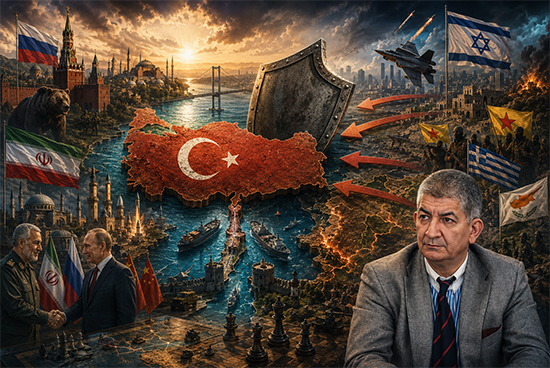
But this is only the beginning. The ultimate objective is the destruction of Turkey. France, Greece, and Israel seek to destabilize Turkey’s political situation, incite the Kurds against the Turkish regime, and draw Turkey into confrontation with Israel in Syria. Ultimately, they intend to plunge the Turkish economy into a deep crisis, disrupt the tourism industry, and expose the country to unprecedented inflation. Clearly, as inflation spirals out of control, an unprecedented flight of capital from Turkey will begin.
In other words, Turkey must be drawn into war in Syria, political opposition must be mobilized against it inside the country, and Kurdish separatists must simultaneously be provoked. On the other hand, Greece should be drawn into a conflict with Turkey over Cyprus, and ultimately, at least a dependent regime should be brought to power in Ankara, thereby achieving the intended objectives.
Ultimately, they must take Istanbul away from Turkey and also seize the Turkish-controlled part of Cyprus. The main reason for this is to establish control over the gas resources beneath the Mediterranean Sea. In itself, the creation of Kurdistan and the separation of Istanbul would effectively lead to the collapse of Turkey.
Although Russia and Iran are not sympathetic to Erdoğan’s policies toward Turkey, they should nevertheless support Turkey, based on their long-term strategic interests and in cooperation with China. Because if Turkey is left on its own, they will lose both the vast resources of the Mediterranean shelf and control over the Bosphorus and Dardanelles Straits, while also facing the emergence of another Israel — in the form of Kurdistan.
Obviously, Pakistan is incapable of providing Turkey with meaningful assistance in its defense. The Arab countries, apart from providing financial support, can offer little else. Egypt remains, but its relations with Turkey are strained. Egypt must also understand very well that without Turkey, it will itself become the next target. Therefore, in practice, only Iran and Russia are capable of helping Turkey.
Of course, Turkey must reach an agreement with Iran over Syria and prevent the Syrian regime from attacking Hezbollah in Lebanon. Because if Syria attacks Lebanon, Iran will be forced to launch missile strikes against Syria, and this would only add fuel to the fire in Israel’s interests.
Second, Turkey should reconsider its policies toward Ukraine and the Caucasus and should no longer put Russia’s interests in these areas at risk.
Putting all of this aside, the fall of Erdoğan’s regime would be extremely detrimental to Iran and Russia. The future regime would be dependent on the West and could cut off all of Russia’s routes to Europe, while also placing Iran under an even tighter economic blockade.
If Erdoğan is overthrown, the next Western-dependent government would close the Dardanelles and Bosphorus Straits to Russia. Therefore, Russia and Iran must not make a miscalculation and allow the United States, Britain, and Israel to “swallow” Turkey.
In a word, there is no alternative to supporting Turkey. If Israel and Greece attack Turkey, Iran must immediately launch missile strikes against Greece and Israel. Iran and Turkey must set aside their differences and cooperate in Iraq and Syria, because the situation is extremely dangerous.
If Turkey reaches an agreement with Iran, they can, on the one hand, neutralize the project of creating a Greater Kurdistan, and on the other hand, if a major war breaks out in Syria, Iran could deploy its ground forces into Syria through Iraq to support Turkey.
Otherwise, Turkey will be left alone, facing Israel and Greece.


