




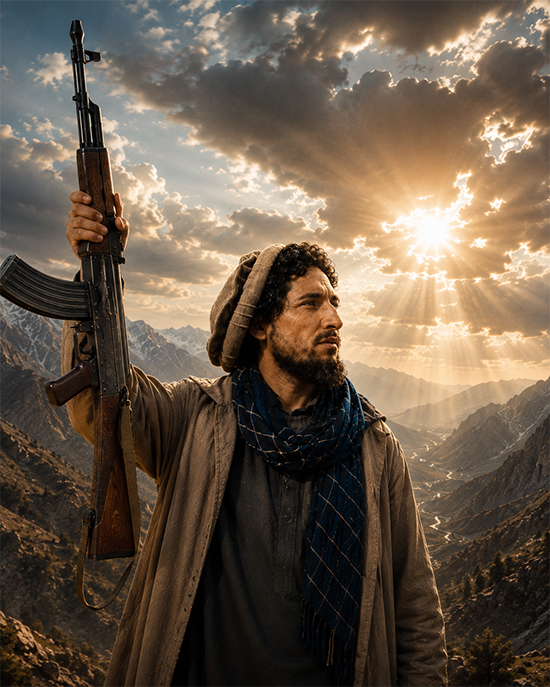
How did Ahmad Shah Massoud connect worship with resistance?
Author: Hafiz Mansour, politician and writer, one of the leaders of the Islamic Society party and the Afghan Resistance Front
In anticipation of the birthday and the anniversary of the martyrdom of Ahmad Shah Massoud (September 1, 1953 – September 9, 2001), the national hero and a legend in the history of Afghanistan and humanity, Sangar has decided to publish a series of articles about him.
Those who fought for the liberation of humanity from the yoke of exploitation, colonialism, terrorism, and extremism will remain forever in the hearts, in the memory, and in legends.
The life of a hero begins after his death!
***
For several days now, some friends and comrades of Ahmad Shah Massoud (may Allah have mercy upon him), on the occasion of the twenty-fifth anniversary of his martyrdom, have been sharing their memories through the media. Among them is Engineer Muhammad Wasel Bazigh, one of the veteran mujahideen and elders, who shared his impressions of the personality of the martyred Massoud.
In his compelling remarks, he said: “Ahmad Shah Massoud drew his strength from the higher realm. Like a solar panel, he drew his energy from the owner of the sun.”
This viewpoint caught my attention and prompted me to offer some explanation of it.
Without a doubt, Ahmad Shah Massoud (may Allah be pleased with him) drew his strength from the Lord of the heavens and the earth, the Divine Throne and the Divine Seat; through seeking recourse to the sacred Divine Essence, he gained strength and moved forward with trust in Him. The truth of this can be understood from studying Hazrat Massoud’s personal notes.
Whenever a shortcoming occurred in his work, or a problem arose, he would examine the situation and, in the process, place the blame upon himself, saying that he had not carried out his duties properly and had been negligent in certain matters.
If he had failed to personally and carefully examine an issue, or had sometimes spoken more harshly to someone, he would privately express regret and remorse and ask God for forgiveness and mercy. He regarded his weakness and laziness as the result of spiritual frailty and inner weariness, which arose from neglecting the remembrance of God and prayer.
Ahmad Shah Massoud (may Allah be pleased with him) was, rightfully, a mystic — a mystic of a particular kind. I consider him the founder of the mystical Tariqa of Massoudiya, which in its essence differs from the Qadiriyya, Naqshbandiyya, Chishtiyya, Mawlawiyya, and Sanusiyya orders.
Among the traditional tariqas, besides the Kubrawiyya, whose imam and leader, Sheikh Najmuddin Kubra, took up the sword and went onto the battlefield against the Mongol army, there also existed lesser-known tariqas in the East and among African Muslims that fought against the English colonizers and demonstrated self-sacrifice. However, other Sufis remained distant from jihad and devoted themselves to teaching and spiritual guidance in their khanqahs.
Massoud established a connection between dhikr and prayer and armed jihad, and demonstrated that these two things can be compatible with one another. The life and deeds of Hazrat were filled with such examples. Traditional Sufis spoke more about their own mistakes and sins and, for this reason, asked the Almighty for forgiveness and mercy. In their view, the attributes of God’s mercy and forgiveness — Rahman, Rahim, and Ghaffar — stood out prominently.
Whereas Ahmad Shah Massoud turned more toward the dignity, greatness, and power of the Lord — Aziz, Jalil, and Qadir; it is precisely this difference in their way of life that distinguishes these two tariqas from one another. Traditional Sufis appeared as people inclined toward seclusion and retreat, with a yellowish complexion and an untidy, humble, and sometimes weary appearance. Massoud, by contrast, appeared among his troops with a clean, distinguished, and cheerful face, an athletic physique, and a proud bearing. His tilted cap and charismatic manner testified to the fact that he placed greater thought on his own dignity and the dignity of others.
One of the obvious differences between him and his other comrades, especially the veterans of the Islamic Movement of Afghanistan, was that the other members of the Islamic Movement regarded prayer as equivalent to action. For this reason, they showed greater devotion to personal worship and daily dhikr. These friends believed that only through prayer and personal worship could one overcome the difficulties of jihad and untie the knots that existed.
However, Massoud regarded prayer and worship as inner preparation and did not consider them sufficient for the struggle; therefore, he planned and worked day and night tirelessly. It was precisely this difference in outlook that placed Massoud in a lofty and unattainable position.
The fourth pillar of the Massoudiya Tariqa is that Massoud (may Allah be pleased with him) regarded the struggle against oppression and despotism as the highest form of worship. Therefore, he called establishing justice among the people and providing them with prosperity and peace the best form of worship. Instead of numerous acts of dhikr, wirds, and additional prayers, he gave this priority in his own view. This characteristic of the Massoudiya Tariqa connected it with society and made it political — political in the sense of being social, and not in any other sense.
The conclusion is that Engineer Muhammad Wasel Bazigh pointed to an important point and, in my view, Ahmad Shah Massoud (may Allah be pleased with him) should be regarded as the founder of the Massoudiya Tariqa — a tariqa with its own pillars, four of which we have mentioned here.
May the souls of all the great ones be blessed, and may Massoud’s (may Allah be pleased with him) abode be the highest paradise!


