




American Weapons Have Created a Major Headache for the Pakistani Army
By Dr. Sahibzada Muhammad Usman, EUR Asia Review (USA)
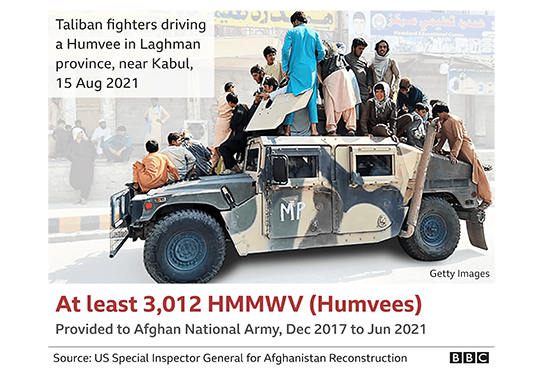
The repercussions of the United States attempting to pull out of Afghanistan in 2021 continue to be experienced in the area despite it being Pakistan who bears a greater responsibility. The military equipment’s provided by the US to the value of billions of dollars that were supposed to have empowered the Afghanistan National Defence and Security Forces were left in the possession of the Taliban once they recaptured Kabul and fully controlled the country. The result of that lost stockpile has leaked to the black market today and, lastly, found itself in the possession of various militants with the largest being the Tehreek-e-Taliban Pakistan (TTP). Not only has this provision of high technology weapons empowered terrorist groups but it has also heightened the violence, and this is destabilizing the borders of Pakistan and diminishing the national security.
One of the most frightening trends is the realization that now the terrorists can easily access the high-quality weapons of the US through their association with the Afghanistan Taliban. It has always been mentioned that M16 and M4 rifles, night-vision goggles and other advanced military gear that was supplied to Afghan soldiers earlier is continuously ending up among militants who are acting within Pakistan. These are weapons that have been deployed in dozens of attacks against security agencies and civilians, particularly in Khyber Pakhtunkhwa where the insurgent violence has been on the upward trend in the past two years. Night-vision gear particularly has given an edge to the terrorists in terms of ambush during the dark so that they can execute more effective and well-organized assaults.
The emergence of power by Taliban following August 2021 created an environment whereby the military equipment of the US military was distributed among the local commanders with majority having weapons within their networks. Instead of creating a single chain of command of all the seized weapons the Taliban decentralized system gave single units an opportunity to utilize these weapons as assets to generate influence, trade or even profit. The spurted liquid has been a black-market boom and at present, advanced guns and equipment is easily obtained by armed groups in the area. These arms have been merely revolutionary to the TTP who have long since been mimicked because of years of restructuring in Afghanistan, and their capability of operation has been multiplied many times over.
It is so because of the high amounts of equipment left behind which add to this proliferation. When the US departed, there was an estimated 7billion military equipment, vehicle and weaponry left in Afghanistan. The case of the United States of America having reclaimed these assets though advanced by the former President Donald Trump never had any valid strategy which was implemented. The Afghan theatre has become an open warehouse of the modern equipment, which is now being shipped to the groups that do not limit their violent intentions to the borders of Afghanistan. The absence of a reimbursement system coupled with the ability or inability of Taliban to restrict the spread of weaponry has created a vacuum in security which has had lethal repercussions to Pakistan.
The United Nations reports have also highlighted the extent to which TTP, and other groups have exploited the US left behind weapons with the Taliban conquest. The outcomes of the UN show that the insurgent groups that invade the Pakistani soil have been empowered by such objects as M16 rifles, M4 carbines, and night-sight devices. The weapons have been used to enhance the strength of professional military forces; in wrong hands, the terrorists, they boost the magnitude and degree of violence. Militants are now armed and their access to weapons which previously was only accessible to high-tech armies are now available to security agencies that are already stretched on other fronts.
This is aggravated by the fact that there is no control of black market which has flourished in Afghanistan. Without the relevant control systems and since the economic conditions are devastating, guns and military supplies have become sold and bought with minimal scrutiny. The very citizens of Afghanistan, who are frightened by the mounting level of criminality and insecurity, are also purchasing the weapons themselves to defend themselves that increases the market but complicates the control of proliferation. Availability of lethal equipment is a long-term threat that has not only long-term effects on not only the security of Pakistan but also the security of the region at large considering that border security is increasingly open to arms trafficking.
Even though the Taliban leadership has refuted on several occasions that they are selling the US made weapons, security experts and professionals have argued that the evidence is overwhelming. The arms that are confiscated within the militants in Pakistan are often embarked with identification that is linked with the equipment that was once supplied to the Afghanistan forces. In a particular case, the Washington Post was shown by the authorities of Pakistan 63 rifles that were all said to have been provided to Afghanistan before the fall by the United States. The fact merely contributes to the concern over the scale of the weapons spread and its enhanced use in the attacks on the Pakistani soil.
The other element that demonstrates the inhumane nature of this proliferation is the economic nature of this proliferation. Pakistani arms merchant Raz Muhammad noted in an interview with the press that the price of night-vision equipment had dropped significantly since the Taliban was in power. These machines had been formerly valued at about 2000 dollars but in the short term were being sold at the low price of 300 and this was a massive indication of their sudden excess supply. The effect of this low cost on the availability of militant groups is drastic as it allows them to carry out operations more precisely but more lethally. The financial incentives that have sustained this trade ensure that it will not end up being a bigger challenge in the long run unless abated through a concerted effort in the region.
Dr. Sahibzada Muhammad Usman holds a PhD (Italy) in geopolitics and is currently doing a Postdoctoral Fellowship at Shandong University, China. Dr. Usman is the author of a book titled ‘Different Approaches on Central Asia: Economic, Security, and Energy’, published by Lexington, USA.


