




Afghanistan Once Again at the Center of Emerging Regional Security Dynamics
Source: Mabna News Agency
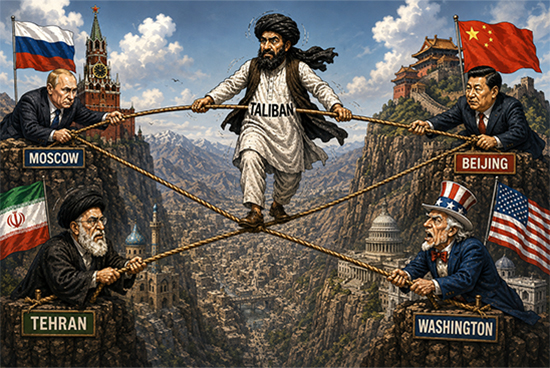
Afghanistan is no longer the forgotten battlefield of the West that it was once perceived to be. Against the backdrop of the war in Ukraine and the crisis in the Middle East, the country has become one of the key centers of regional security dynamics, where Russia, Iran, China, India, and Pakistan are all seeking their place on a complex geopolitical chessboard. This article examines the evolving power competition surrounding Afghanistan and the future that is currently taking shape.
Recent developments indicate that Afghanistan is gradually losing its status as a direct security priority for the West, particularly for the United States. While Afghanistan served as the focal point of U.S. and NATO military engagement over the past two decades, the war in Ukraine, the Middle East crisis, and the strategic rivalry between the United States, China, and Russia have significantly reduced its prominence on the Western agenda. Yet it is precisely this vacuum that has increased Afghanistan’s importance in regional calculations, transforming it into a crossroads of Russian, Chinese, Iranian, Indian, and Pakistani interests.
Afghanistan and the Reconfiguration of Regional Competition
Regional powers now view Afghanistan as an integral part of their security and geopolitical interests. Russia sees it as a component of Central Asia’s security belt; China links the security of its Belt and Road Initiative to stability in Afghanistan; Iran regards Afghanistan as strategic depth on its eastern frontier; India views it as a balancing factor against Pakistan; and Pakistan continues to seek the preservation of its traditional influence in the country.
As a result, Afghanistan has once again become an arena of great-power competition. This time, however, the contest is taking place not through direct occupation, but through security arrangements, proxy conflicts, and competition over transportation and trade corridors.
Taliban–Russia Rapprochement: The Beginning of a New Phase
The growing rapprochement between the Taliban and Russia, particularly in the fields of security and technical cooperation, reflects a significant shift in Moscow’s perception of the Taliban movement. Russia increasingly views the Taliban as part of the region’s security architecture rather than merely an insurgent group.
There has also been speculation that Russia could potentially make use of Taliban manpower or fighters affiliated with the movement in the context of the war in Ukraine. Although such claims have not been officially confirmed, the very existence of these discussions suggests that Afghanistan is entering a new phase of regional relevance and political influence.
The Possibility of Further Iran–Taliban Convergence
In the event of an escalation in tensions between Iran and the United States and Israel, the possibility of closer ties between Tehran and the Taliban, as well as a potential formal recognition of the Taliban by Iran, becomes a subject of discussion. Iranian policymakers appear to have concluded that instability in Afghanistan could transform the country's eastern borders into a sphere of influence for ISIS-Khorasan and a theater for proxy conflicts.
For this reason, Tehran may pursue a more pragmatic form of cooperation with the Taliban within the framework of regional security arrangements, particularly if a broader confrontation emerges between the Iran-led axis and the U.S.–Israel axis. Some analysts also speculate that Iran could welcome the participation of Taliban-affiliated jihadist forces in a conflict against Israel.
Pakistan’s Multi-Layered Strategy
Pakistan remains the most complex and controversial regional actor in the Afghan equation. On the one hand, Islamabad faces security tensions and border disputes with the Taliban. On the other hand, it seeks to preserve its traditional role in managing developments in Afghanistan and safeguarding Western interests in the region.
Recent visits by Pakistani officials to the United States, along with intensified diplomatic activity following the rapprochement between the Taliban and Russia, may indicate growing concern in Islamabad that Afghanistan is gradually moving beyond Pakistan’s traditional sphere of influence.
Furthermore, Russia, Iran, and India may have concluded that some anti-Taliban networks and elements affiliated with ISIS-Khorasan are being managed through structures linked to Pakistan. The spread of instability from Afghanistan into Central Asia, China, and Iran effectively serves as a tool of pressure against regional powers.
Afghanistan–Pakistan Rivalry: From Economics to Security
The rivalry between Afghanistan and Pakistan has long moved beyond a simple border dispute and has become part of a broader geopolitical competition in the region. Afghanistan is seeking to reduce its economic dependence on Pakistan and connect itself to alternative routes and projects, including the Chabahar Port, Central Asian markets, and various regional transportation and economic initiatives.
At the same time, the growing ties between the Taliban, Russia, Iran, and China could alter the regional security balance, weakening Pakistan’s traditional monopoly over influence in Afghan affairs.
Conclusion
The world is moving toward a multipolar order, and Afghanistan finds itself at the center of this transformation. The decline of Afghanistan’s importance in the West’s direct policy agenda does not mean a reduction in its geopolitical significance. On the contrary, the country now occupies an even more important position within the framework of regional competition.
The Taliban’s rapprochement with Russia, the possibility of strategic cooperation with Iran, competition with Pakistan, and the struggle over transportation corridors all indicate that Afghanistan has entered a new phase of regional engagement. However, if the country fails to develop an independent strategy for protecting its national interests and maintaining regional balance, it may once again become an arena for proxy conflicts among major powers.


