




To what extent are external pressure and internal discontent interconnected?
Author: Mohammad Qadir Mesbah, expert on regional affairs
The meeting between Donald Trump and Benjamin Netanyahu in Florida and the statements made by both sides became part of an explicit political and security message emphasizing the continuation of full U.S. support for Israel and the intensification of pressure on Iran. By highlighting Netanyahu’s role in Israel’s survival and pointing to Iran’s unfavorable economic situation and the threat posed by its missile programs, Trump sought to reinforce the image of mounting pressure—security, economic, and psychological—against Tehran.
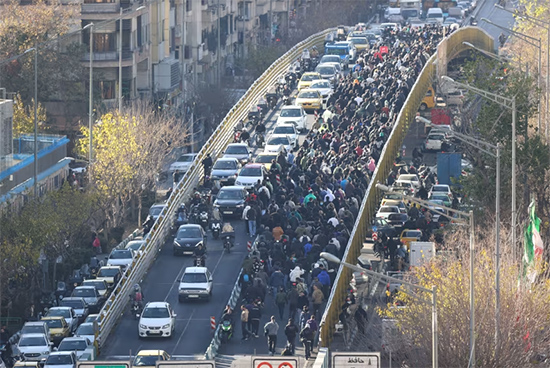
These positions were voiced at a time when signs of public dissatisfaction and social protests were also observed inside Iran in several cities, as reported by Iranian and Persian-language foreign media. Although the root causes of these protests are said to be livelihood problems, inflation, and economic pressure.
At the same time, during some demonstrations, slogans were heard that went beyond economic demands, including calls for the return of the Shah. This slogan reflects less the existence of a coherent political project or the will of the majority of Iranian society, and more the radicalization of protest language and a symbolic expression of deep dissatisfaction with the current situation.
The general and prevailing analysis is that there is no direct, organized cause-and-effect relationship between these protests and Netanyahu’s visit or his meeting with Trump, just as there is no credible evidence of external direction of the protests or their practical linkage to this political meeting. Nevertheless, these two phenomena cannot be considered entirely unrelated, as they unfold within a shared environment of pressure and political perception and significantly influence how each other is interpreted.
From the perspective of international politics, the coincidence of internal discontent with intensified external pressure conveys to external actors the impression that Iran is facing simultaneous challenges both domestically and internationally. In this context, slogans such as “the return of the Shah” are viewed not as a real alternative to power, but as indicators of social fragmentation and the erosion of legitimacy—at least within part of society. Such perceptions may influence the tone, timing, and intensity of foreign policy positions without implying direct interference in internal developments.
On the other hand, external pressure alone can indirectly contribute to the radicalization of internal slogans. In conditions of growing threats and sanctions and unclear prospects for short-term improvement, part of society adopts a maximalist and symbolic language of protest. This reaction more accurately reflects the psychological and political state of society at a moment of crisis than it does the formation of a new political consensus.
Overall, it can be acknowledged that Iran’s internal protests are neither the result of the policies of Trump and Netanyahu nor a determining factor in their decisions. However, alongside intensified external pressure, they create an atmosphere of simultaneous internal and external pressure in which every development acquires greater political meaning and weight. In this framework, the slogan of the Shah’s return is a sign of the radicalization of a segment of public discontent, rather than an expression of a practical and dominant path for Iran’s future political development.


