




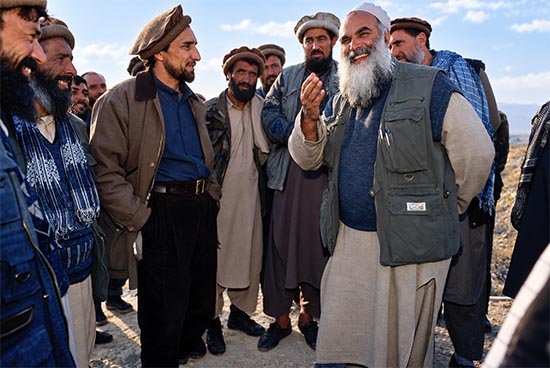
How significant was Sayyaf’s role in the assassination of Ahmad Shah Massoud?
Author: Ubaid Noori, Kateb Media
The assassination of Ahmad Shah Massoud on 18 Sunbula 1380 (September 9, 2001) — just two days before the September 11 attacks in the United States — remains one of the most complex political and intelligence cases in Afghanistan’s modern history. The event not only changed the course of the war in Afghanistan but also left behind numerous serious questions about the involvement of domestic and transnational forces in his elimination — questions that, due to subsequent political considerations, were never examined by any court.
The operation to assassinate Massoud in Khwaja Bahauddin, Takhar Province, was carried out through a carefully planned, multilayered infiltration scenario:
- The operatives: two terrorists of Tunisian origin (Dahman Abd al-Sattar and Bouraoui al-Ouaer), carrying forged Belgian passports, presented themselves as journalists from an Arab media center in the United Kingdom.
- Method of the attack: explosives had been professionally concealed inside a camera and in belts worn under their clothing. During the interview, the camera exploded, killing Massoud and one of his companions (Asim Suhail), as well as one of the attackers.
The central internal question in the case of Massoud’s assassination concerns how these two al-Qaeda operatives managed to reach the Northern Front’s forward positions and ultimately enter the room where Massoud was being interviewed. They had waited for weeks in areas controlled by the Northern Front, and their access was directly facilitated through letters of recommendation and coordination by Abdul Rab Rasul Sayyaf.
Two main scenarios have been put forward regarding Sayyaf’s role:
- The negligence and longstanding ties scenario: Sayyaf and his defenders argue that, because of Sayyaf’s long history dating back to the jihad of the 1980s and his extensive ties with Arab groups, he trusted these men, regarding them as Muslim journalists and like-minded individuals. According to this version, Sayyaf was unaware of their true intentions and, acting solely out of political optimism, issued an official letter of recommendation to facilitate their work.
- The collusion and deliberate facilitation scenario: critics and some people close to Massoud raise the question: how could the Northern Front’s security service and Sayyaf personally have disregarded basic screening and identity-verification procedures? According to this version, Sayyaf, as a figure with pronounced Salafi/Wahhabi views, had an interest in Massoud’s elimination, since Massoud was regarded as an obstacle to the growing influence of traditional religious currents and to future power-sharing arrangements.
Massoud’s assassination cannot be analyzed separately from the region’s political geography and al-Qaeda’s transnational strategy:
- The deal between al-Qaeda and the Taliban: Osama bin Laden and Ayman al-Zawahiri presented the elimination of Ahmad Shah Massoud as a “strategic gift” to Mullah Mohammad Omar (the Taliban leader at the time). Al-Qaeda knew that the September 11 attacks were imminent and that the U.S. response would lead to the fall of the Taliban regime. Therefore, by eliminating the only prominent commander opposing the Taliban, they relieved the Taliban of concerns about the internal front in order to secure their continued support for bin Laden.
- The silence of regional intelligence services: the infiltration of two Arab terrorists carrying forged documents from Europe all the way to the front lines in northern Afghanistan appeared impossible without a “green light” or, at the very least, deliberate inaction on the part of regional intelligence services.
The most striking aspect of Massoud’s assassination case is that throughout the 20 years of the Hamid Karzai and Ashraf Ghani governments — when Massoud’s supporters held key positions in the ministries of defense and interior, as well as in the national security apparatus — neither an independent fact-finding commission nor an international tribunal was ever established to investigate the assassination.
The main reasons why the case was effectively buried were:
- Preserving the political coalition in Kabul: prosecuting or formally interrogating figures such as Sayyaf could have shattered the fragile ethnic and factional coalition within the Kabul government.
- U.S. and NATO considerations: reopening the investigation into Massoud’s assassination could have led investigators to certain regional and international intelligence networks whose cooperation Washington needed to conduct the “war on terror.”
- Truth sacrificed for political expediency: just as the crimes of the 1990s were left without proper investigation, the mystery surrounding Massoud’s assassination was also sacrificed to immediate political interests and the division of power in Kabul.


